
Trunk Show
Oregon winegrowers embrace the ancient method of head-trained vines
By Branden Andersen
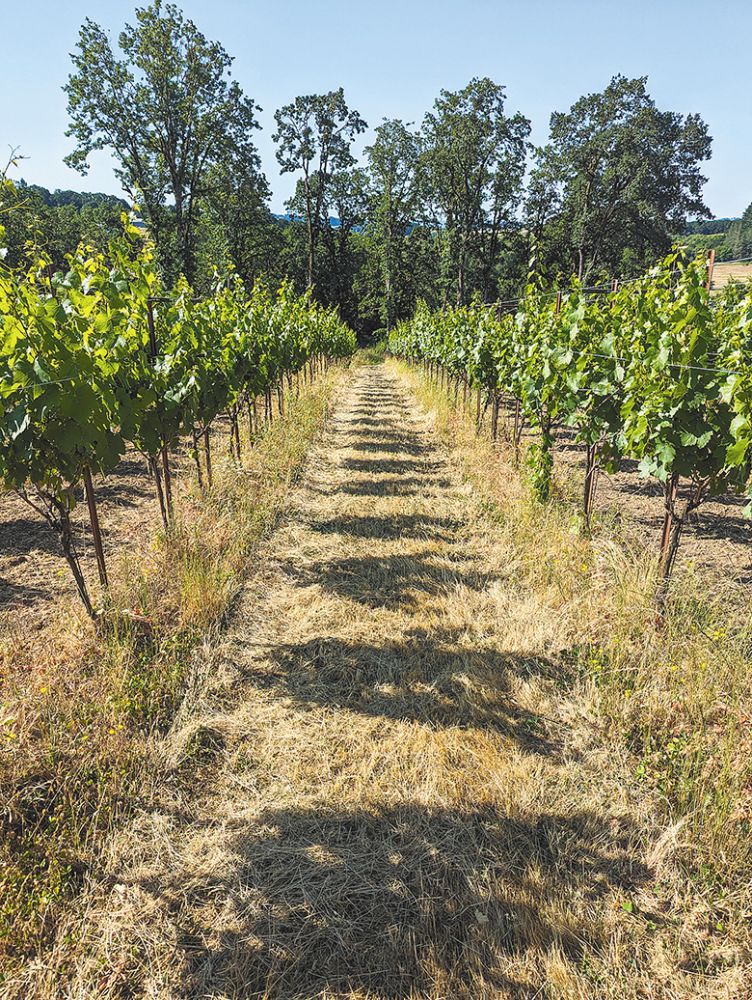
The sky over Concinnitas Farm in Yamhill was blue and bright. While still a brisk February day, the weather was unseasonably dry and warm, with highs in the low 50s. The surrounding hills were bare of snow, and spring felt right around the corner– two months ahead of schedule.
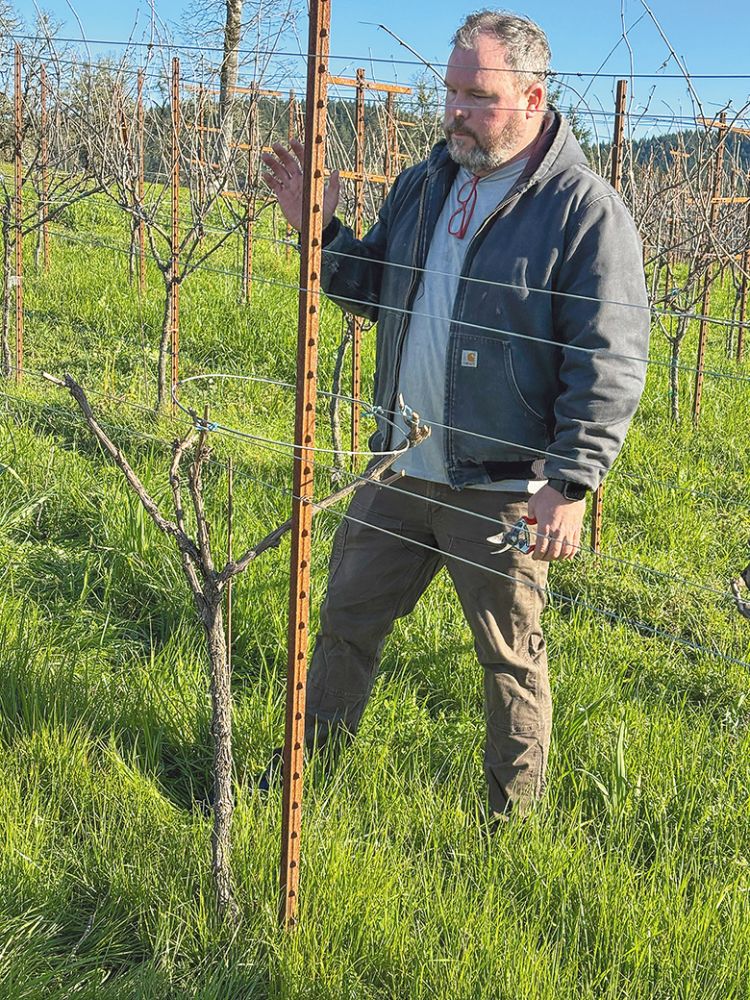
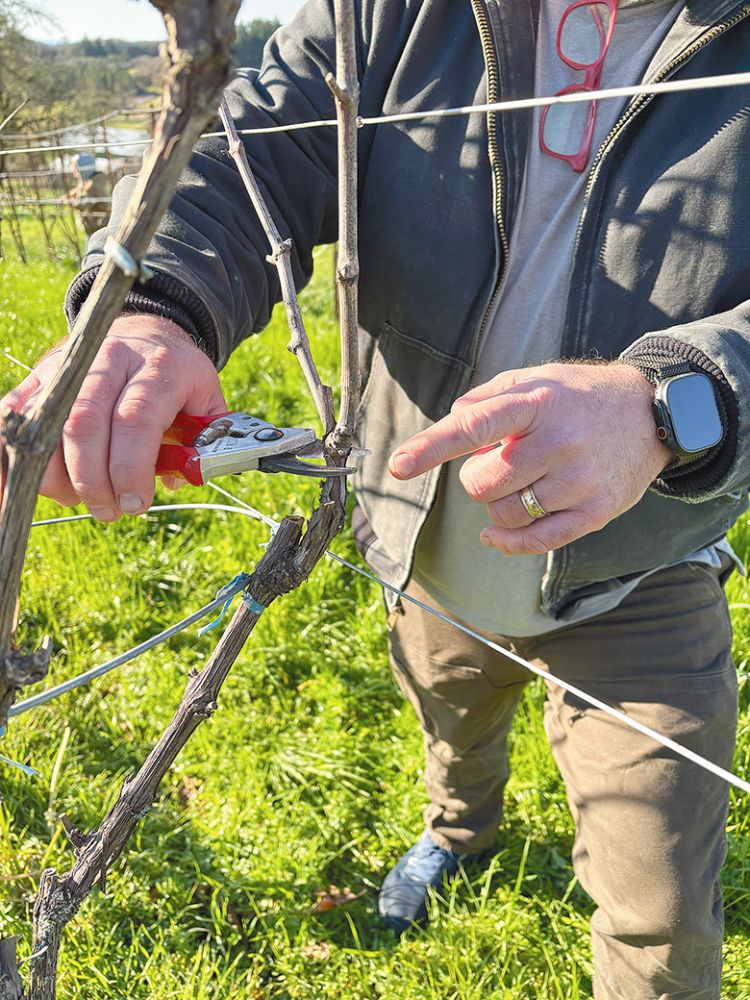
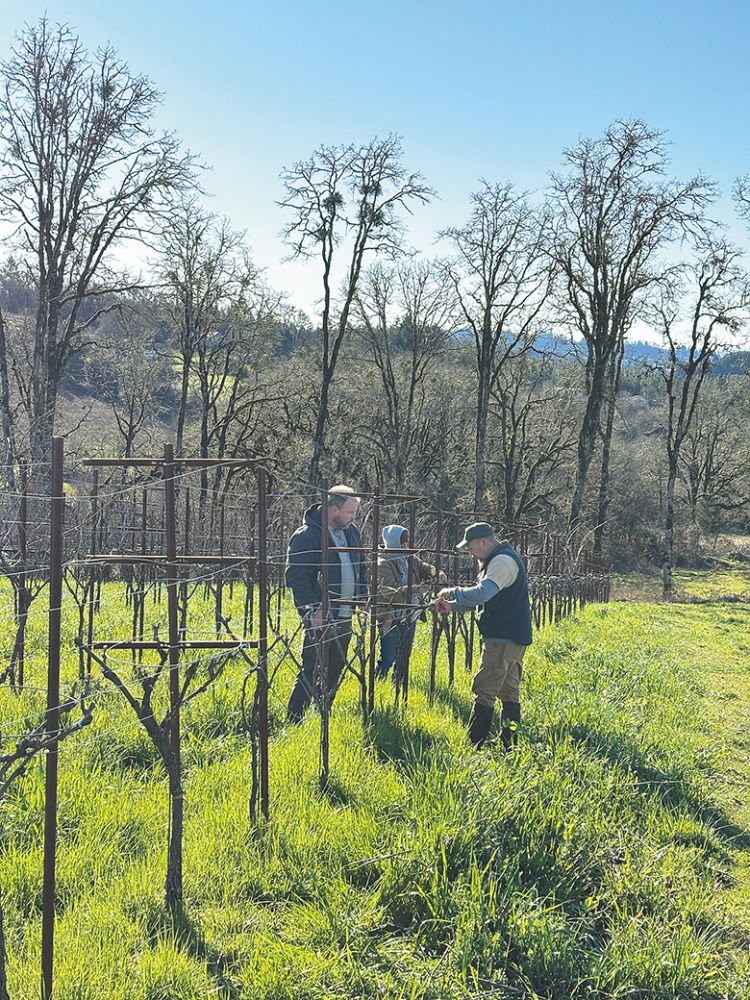
Enologist Chad Stock was working with Sterling Vineyard Management operations manager Juan Cruz, pruning vines in a style the Willamette Valley rarely sees: a head-trained vine.
“Think of it like a goblet, or an umbrella turned inside out,” Stock explained as he inspected vine positioning to identify the best candidates for pruning. “It’s the start of what will essentially be a grape tree.”
Stock, who manages Concinnitas and co-owns Limited Addition Wines with his wife, Master of Wine Bree Stock, was pruning a block of Gamay Noir that morning alongside Cruz. Together they examined each vine, shaping the eight-year-old plants with a vision of what they would look like in eight more years.
“It’s been a pretty amazing learning experience,” Stock noted. “We understand it all conceptually, but actually living through it– having the experience– has been really great.”
A DIFFERENT ARCHITECTURE
Driving through the Willamette Valley, most vines are trained on a vertical shoot position system, or VSP, a trellis with parallel wires that restricts canopy growth, forcing it upward, rather than out. Growing vines along a flat plane is a popular style because it’s neat, tidy and easier to harvest.
Head-trained vines, by contrast, are pruned so all the spurs (permanent arms) are positioned around the top of the trunk, usually no more than a few feet from the ground. Resembling a small, gnarled bush, the French call the style en gobelet.
In pockets of Napa Valley and Lodi, along with arid parts of Spain, you can find them: old, gnarled vines planted 60, 70, 80 years ago, standing strong and sturdy like stocky grape bushes.
But Stock is not replicating the old-world style for nostalgia’s sake. He has practical reasons for training vines in this manner.
“The more branches in different directions and places, the healthier the trunk,” Stock explained. “It will have increased nutrient flow and sap, significantly prolonging the life of the vine.”
The science comes down to vascular flow. A grapevine trunk distributes water and nutrients through its xylem and phloem– the vascular tissue protected by the outer surface. On a VSP-trellised vine, one or two arms run in only two directions. Dead wood builds up, decay can set in and pressure from disease and pests increases as parts of the trunk eventually starve.
“Some of the oldest places where vines are still being grown– they can be over 100 years old– are head trained,” Stock stated. “They’re much less likely to have a lot of dead wood on the inside.”
KNOW WHAT YOU’RE GETTING INTO
Bryan Berenguer, vineyard management instructor at Chemeketa Community College’s Wine Studies program, has experience with head-trained vines in France and understands their appeal.
“A head-trained grapevine receives sun and light exposure all around the cluster and canopy,” Berenguer reported. “Increased airflow also contributes to lower disease pressure. These factors can produce a very high-quality grape. You will often see this in dryer climates with varieties that grow upright, where lack of water and poor soils restrict shoot growth.”
But Berenguer isn’t sure the method necessarily moves the needle enough for the Willamette Valley’s climate…yet. Despite a 2022 published study, co-authored by Berenguer, citing decades of climate data showing the area is gradually warming, it remains categorized as a cool climate for grape-growing.
Varieties that thrive in the Willamette Valley– Pinot Noir and Chardonnay– prefer to flop down and over, making them poorly suited for training in the goblet shape. Even upright growing varieties like Gamay will flop over once the shoots get high enough, and they often do in the Western Oregon climate, with plentiful rainfall and fertile soils. Managing them requires tying the shoots of the vine to a post to keep them upright, increasing labor and time. “And if you’re doing that, it may negate some of the benefits from an open crown,” Berenguer observed. “You’ll get good airflow, but I don’t know about light. And at a certain point, you need to evaluate whether the added economic cost of the work is worth the benefits.”
Harvesting adds another layer of difficulty. Clusters scattered around a “grape bush” rather than aligned along a trellis make picking more labor-intensive– and expensive.
“That’s why you don’t see many people here doing it,” Berenguer added. “It’s very hard to manage.”
LEARNING BY DOING
Stock admits the training style is far more difficult than VSP. A head-trained vine requires years to shape; a VSP vine takes two at most.
Stock began converting the Gamay block in 2018 and was still refining the structure vine by vine. The goal is four to six arms radiating outward from the head– the “goblet” shape– low and open at the center to allow airflow and even light distribution.
Training each grapevine’s arms to spread in all directions while managing shoot length, bud count and trunk height requires individual plant assessment.
“You only get one cut,” Stock shared. “And if you’re like, ‘Whoops, wrong cut’– it can take a few years to fix.”
Cruz, who has worked in vineyards for 16 years, demonstrated the necessary precision. He explained the renewals and removals– the shoots to preserve, which directions to train toward, and how to create “nice open space” at the center.
A CREATIVE CHOICE
While Stock is experimenting and testing the method’s effectiveness in the Valley, the team at Dominio IV first began experimenting with head training in the Gorge.
Cofounder Patrick Reuter’s fondness for labyrinths started when he was young. When he and Leigh Bartholomew founded Dominio IV in 2002, they incorporated the design into their logo and hoped eventually to build one in the vineyard.
A decade later, in 2012, to ensure the plants received proper sun exposure in their Mosier vineyard, Bartholomew formed a labyrinth with head-trained vines. Each ring features a different grape variety: Tempranillo, Syrah, Cabernet Franc, Malbec and Petit Verdot.
“It is definitely a stylistic choice, and doesn’t provide as much fruit as the rest of the vineyard,” confessed Dominio IV business manager Stephen Fouch. “But it is part of our story, and provides a unique way for our guests to walk the vines.”
Yields are low but sufficient for a labyrinth field blend from all the varieties grown on those vines. The 2023 vintage produced 148 cases.
In 2017, Dominio IV planted a second grape labyrinth at its Carlton Shallow-blue-sea Vineyard. There, each ring features different Pinot Noir clones.
TESTING AND TRYING
The rounded canopy on head-trained vines casts more shade by diffusing sunlight over the course of the day. For a VSP vine, the flat wall of foliage is engineered to maximize sun exposure.
“Head-training actually decreases sunlight on the fruit,” Stock explained. “Thereby slowing down the ripening. By decreasing ultraviolet light on the fruit, the wine will be more aromatic, lighter on its feet, a bit fresher and higher in acidity.”
At Limited Addition, that spirit of experimentation extends across vineyard management and winemaking alike.
“Sometimes people say something won’t work or isn’t worth it, but it’s just because someone told them that was true,” Stock said. “And maybe someone told that person. At some point, we can no longer determine the validity of that information because circumstances have changed. It’s worth testing things out to know for sure.”
Branden Andersen is the founder and publisher of Newsberg, an independent, community-focused news outlet serving Newberg and Dundee. As a reporter in Oregon’s wine country, he regularly covers the people and places that shape the Willamette Valley wine industry. Learn more at newsberg.org.