
Train of Thought
Buona Notte’s The Stazione brings Italian varietals, porchetta and Columbia Gorge terroir to Southeast Portland
By Ron Scott
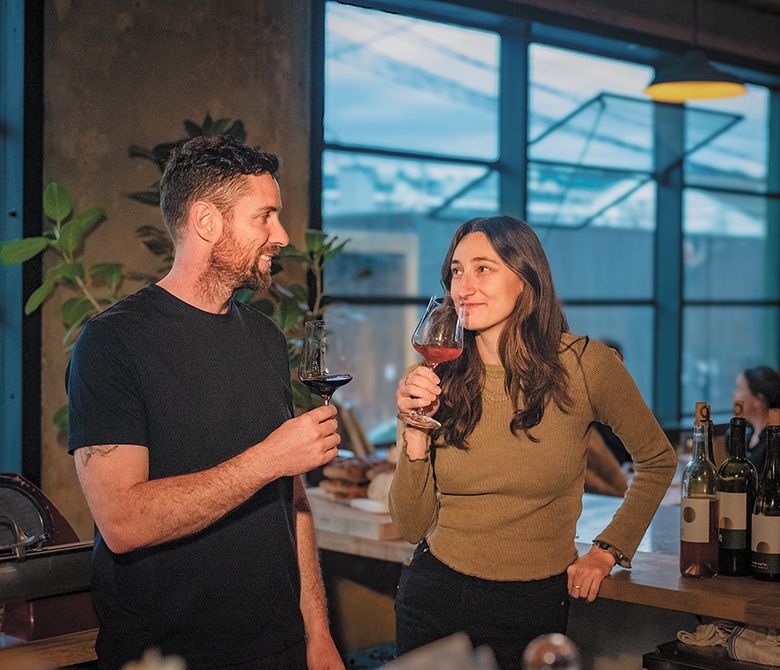
At The Stazione (Italian for station), the sound of nearby trains forces its way into the room. Boisterous horn blasts abruptly interrupt casual chit-chat, prompting awkward chuckles from guests. The noise momentarily disrupts the spell cast by sunlight, slow-turning vinyl records and glasses of Gorge-grown wine in The Stazione’s old-world industrial Southeast Portland wine bar.
For Graham Markel, founder and winemaker of Buona Notte Wines, the disturbance is so unavoidably foundational to the concept that he baked it into the name.
“I’ve been dealing with it for a year and a half now,” explains Markel. “Every time one goes by, it’s a little annoying, but also part of the charm. That’s the reason we call this The Stazione.”
The Stazione, which opened in April, is the new urban outlet for Buona Notte, Markel’s Portland-based winery built around Italian varietals and a deep affection for the fruit and terroir of the Columbia Gorge. The 600-square-foot room replaces The Appartamento, Buona Notte’s former upstairs bar. The Stazione is roughly three times the size, but the move wasn’t simply about fitting in more patrons. The downstairs– previously used as a storage room– provides something the previous space could not: room to cook, pour espresso, play records, sell flowers, and host larger groups. It also allows Buona Notte’s physical presence to become a fuller, food-and-wine-driven venue to better showcase its wines.
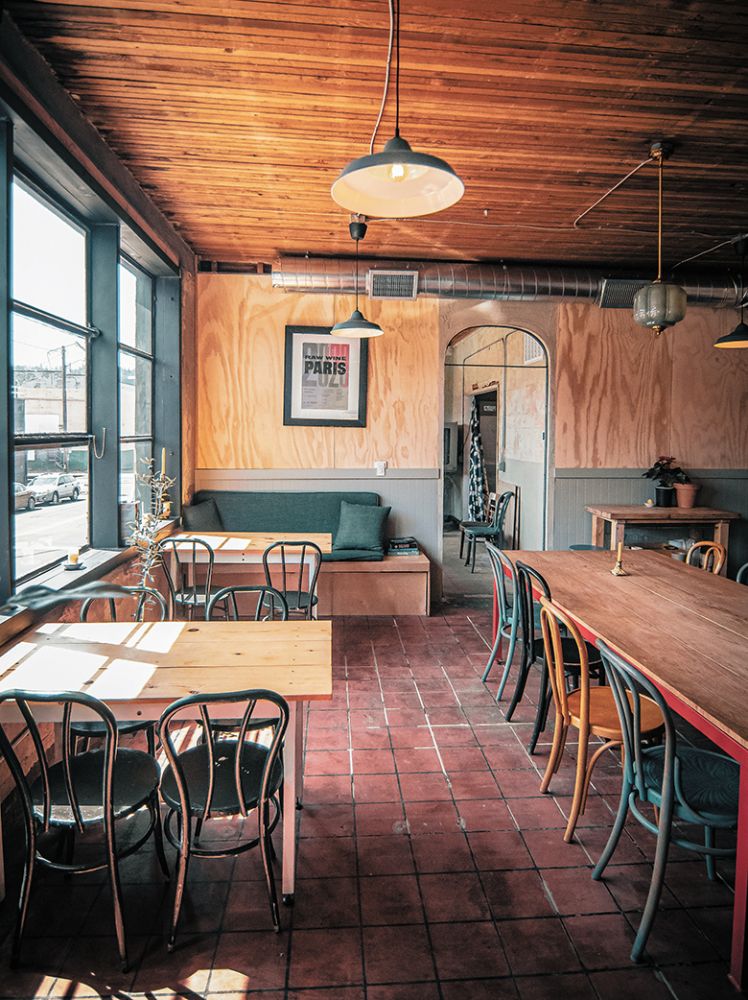
The black arched doorway to The Stazione– similar to the one on the exterior of the building– appears to be original. A fanlight transom with angled muntins adds old-world allure. Inside, pale-finished plywood walls sit above muted sage-green wainscoting, while marble bar tops provide a contemporary touch. Local flowers for sale in the corner soften the rustic-industrial edges; mismatched vintage plates, faded red tile floors, painted stools and wooden chairs supply lived-in warmth. Behind the range, glossy zellige-style blue subway tile anchors the open kitchen. The space, though new, doesn’t feel newly imposed. Instead, many of its details seem coaxed out of the building, as though it had been there all along.
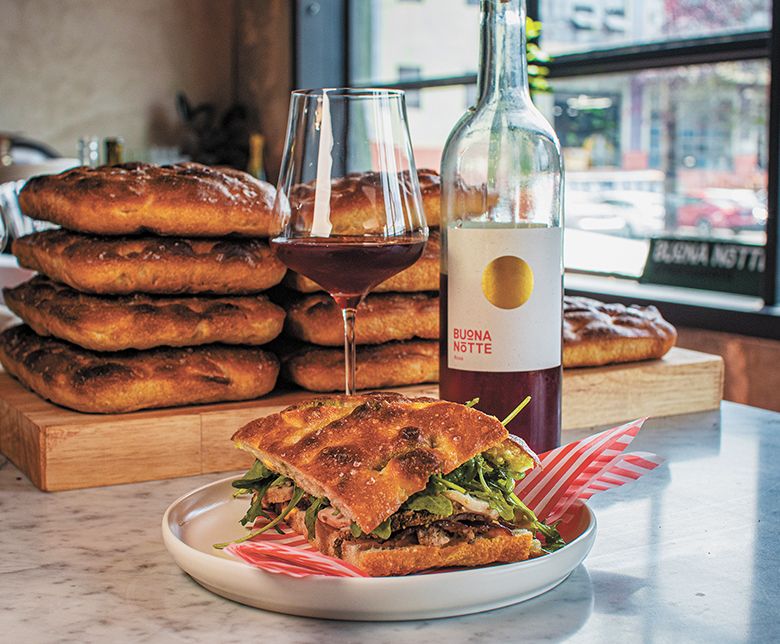
Here, the expanded role of this wine bar is found in its menu. Tight and focused, it’s a supporting cast to the wines rather than a competitor: charcuterie boards composed of goods from nearby purveyors, boquerones toast, tuna with peppers and potatoes, olive oil cake and a porchetta sandwich that essentially defines the early opening ethos.
“My whole dream for opening at 11:30,” explains Markel, “is just to serve really good porchetta sandwiches out of here.”
This sandwich is the lunch program’s center of gravity. Built on neighboring bakery Good Dough’s focaccia, it stacks slices of porchetta with briny salsa verde, spicy aioli and arugula dressed with Laudemio Frescobaldi olive oil. Supremely lavish, it carries grassy-herb richness through the bread, pork and greens, while lemon, capers, olives and mustard keep the salsa verde bright and savory. It all but begs for a lightly acidic accompaniment. Two of Buona Notte’s wines answer that call especially well: Rosa, the darker, earthier rosé, and the red Cento Per Cento. Both come through with enough brightness and zip to cut through the porchetta and olive oil, refreshing the palate without smothering the sandwich’s subtleties.
That balance captures Buona Notte’s motto well: “driven by wine but ruled by its belly.” The food isn’t an afterthought; it’s the table where Markel wants the wines. Buona Notte makes roughly a dozen wines from a roster of vineyards stretching from Underwood, Washington, to The Dalles. With no land of its own, the winery sources fruit from Columbia Gorge growers working everything from backyard-scale plots to 80-acre vineyards. “I really love the people I work with,” Markel declares. “That’s been kind of the driving force behind the longevity.”
For Markel, the Gorge offers more than a convenient source of fruit near Portland. The area’s mix of elevations, soils, rain-shadow shifts and diurnal temperature variations allows Buona Notte to operate outside the typical Burgundian paradigm of the Willamette Valley.
“When I first started, I intentionally chose not to make Pinot Noir,” Markel notes. “There are so many great winemakers already doing that, and it’s such a competitive thing. I wanted to focus on something that spoke to me a bit more.”
That path has led to wines like Rosalba, a ramato-style Pinot Grigio from Underwood, grown at 1,400 feet on an extinct volcano overlooking the Gorge. Having spent six days on the skins, it pours a deep rusty amber, with more tannic grip than Pinot Gris expressions more commonly found in the region. Cento Per Cento, a Sangiovese from Threemile Vineyard in The Dalles, serves as Buona Notte’s flagship wine. After hand-cranking the grapes through a basket press, the wine spends one year in 600-liter barrels and another in the bottle before release. The result is not a showpiece red so much as a workhorse table wine: bright, useful and ready for pork, tomato, bitter greens or whatever else shows up hungry.
This wine list doesn’t lack for range. Gesso is a traditional-method sparkler made with Chardonnay and Pinot Grigio. Its name refers to the acrylic-based primer used to prepare a canvas before painting. Gesso openly reflects Markel’s approach: as a first pour, it primes guests for the evening ahead. Although some of the Buona Notte expressions and grape varieties might be less familiar to casual wine lovers, Markel is careful to keep The Stazione from feeling like a classroom. He’ll happily talk through ramato Pinot Grigio, volcanic soils, skin contact or the Gorge’s cross-border identity when guests inquire, but the goal isn’t to make every customer sit through a lesson.
The same approach extends to food pairings. “I do offer suggestions,” Markel shares, “but I also just want people to enjoy themselves. It doesn’t always have to be centered on education. Having the wine and meal you want guarantees a good time.”
So far, customers seem to be doing just that. Orange wine, especially Panna Cotta– a skin-contact Chardonnay– has been a hot seller, owing as much to the popularity of orange wines as to the seasonality of the opening. “Right when we opened, it was really warm and spring-like,” describes assistant winemaker Mareka Tsongas. “Portland comes alive again after winter, and with all the light in here, people just wanted a cool, juicy wine.”
Bottles are selling well, thanks to affordable pricing and a modest $10 corkage fee. Charcuterie boards and olives are popular, though Markel hopes guests come to regard The Stazione as more than a wine bar with snacks.
The constraints of the room nonetheless help define The Stazione’s identity. No sprawling restaurant kitchen, and thus no lengthy menu. On busy nights, that same homey, snug spirit animates the space.
The result is less like a traditional tasting room, not quite a restaurant, and unlike the common wine bar. Buona Notte’s wines are the main draw, as they were at The Appartamento. The Stazione simply gives them more company: espresso, porchetta, vermouth, records, flowers and space where guests can stay awhile.
Buona Notte Wines’ The Stazione
133 S.E. Salmon St., Portland
Wed. – Thurs.: 11:30 a.m.- 9 p.m., Fri. - Sat. 11:30 a.m.- 10 p.m.
buonanottewines.com
(303) 818-3525
Ron Scott is a Portland-based writer and photographer covering food, wine, beer and spirits across Oregon and the Pacific Northwest. His work has appeared in Portland Monthly, Eater Portland, Sip Magazine and Willamette Week. He is passionate about regional food and beverage as well as hospitality, especially the operational details wherein sourcing, setting and service shape the guest experience.