
Sky’s the Limit
How agricultural drones are elevating vineyard management
By Paula Bandy
For years, whenever aphids appeared on my indoor herbs, I reached for a simple homemade remedy: cinnamon and cayenne mixed with water and sprayed by hand across the leaves. It wasn’t sophisticated technology. I was simply a gardener trying to protect a few plants.
Today, Oregon agriculture is applying similar ideas– natural products, targeted applications and minimized waste– using technology that provides a glimpse into agriculture’s future.
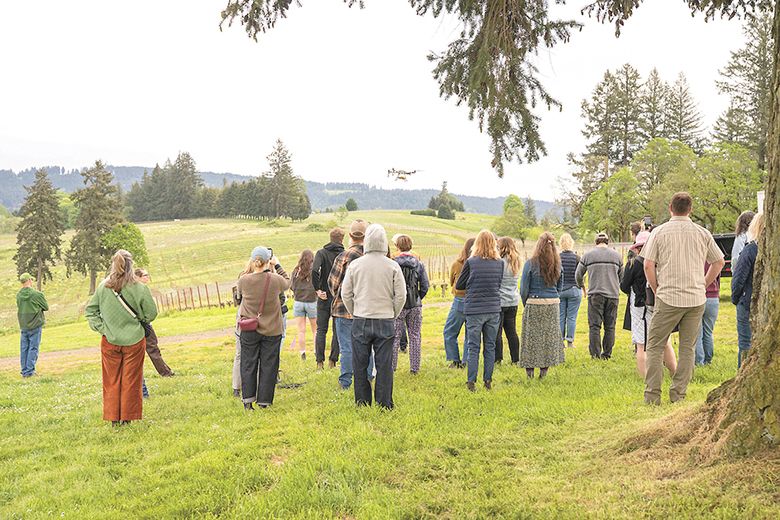
Instead of a hand sprayer, imagine an autonomous aircraft carrying 20 gallons of material. It flies 10 feet above a vineyard canopy, navigating by GPS, adjusting droplet size in real time and returns automatically for a battery change before resuming precisely where it left off. This technology is already operating across thousands of acres in Oregon.
“We started drone applications in 2023,” noted Lane Marsh, ag-services technology lead for Pratum Co-op. “Immediately after graduating from Oregon State, I became a certified drone applicator.”
Based in the Willamette Valley, Pratum Co-op uses agricultural drones for a variety of crops, including blueberries, caneberries, hazelnuts, grass seed, and increasingly, grapes.
WHY DRONES?
Growers have long relied on tractors, ground rigs and traditional aircraft for spraying– drones simply do it better in certain conditions. Unlike tractors, drones have no ground contact, eliminating soil compaction and crop damage. Unlike larger aircraft, they can operate close to the canopy and navigate smaller or more challenging sites, such as steep slopes or wetter areas. For vineyards, that flexibility may prove especially valuable.
Many vineyard blocks include hillsides, uneven terrain or areas where equipment access is challenging. Marsh said recent improvements in terrain-following technology are expanding what drones can do.
“The technology is rapidly evolving,” he observed. “Every year delivers game-changing upgrades.”
WHAT ARE THEY SPRAYING?
In Oregon vineyards, Marsh reported sulfur applications currently account for most of the drone work. Sulfur is an important tool in managing fungal diseases in vineyards and is widely accepted in organic production systems.
Pratum has also applied a concentrated cinnamon-oil product, a broad-spectrum natural botanical miticide and fungicide used to help manage vineyard pests and diseases. When I mentioned my own use of cinnamon and cayenne sprays on herbs, Marsh immediately recognized the connection. “It’s the very same concept,” he acknowledged.
Pratum’s drones have sprayed nettle tea on grapevines, although Marsh noted those applications were primarily for research and educational purposes rather than part of a commercial vineyard program.
Most wine grape applications are currently concentrated in the Willamette Valley. Marsh cited work with vineyards, including Forest Hills Farms near Gaston and McMinnville’s Coeur de Terre Vineyard.
GROWTH HAS BEEN RAPID
Perhaps the most surprising aspect of the technology is how quickly it has advanced. When Pratum launched its drone program in 2023, the aerial equipment could carry seven gallons of liquid. Drones treated roughly 3,300 acres that season. Today, with upgraded models, the company’s drones are capable of carrying about 20 gallons of liquid and approximately 150 pounds of dry material. The results are dramatic.
“With bigger tanks, larger battery capacity, flight speed and everything like that– we’re looking at 18,000 acres,” Marsh shared.
That’s more than a fivefold increase in the span of a few years. Speed has increased as well. Marsh stated that the drones can now fly up to 29 miles per hour in suitable conditions, allowing operators to cover significantly more ground than earlier models.
The newest generation can also adjust droplet size during flight using rotary atomizer technology. Precise droplet control matters because drift management remains one of the industry’s biggest concerns. “The primary thing when you’re a drone pilot is focusing on proper application,” Marsh explained. “Do everything you can to minimize drift.”
MORE THAN A REMOTE-CONTROLLED AIRCRAFT
The popular image of a drone pilot manually steering an aircraft doesn’t match today’s reality. Operators map field boundaries and establish application parameters, then allow onboard software to guide the aircraft.
“The pilot only needs to tap two buttons and one swipe on the screen,” Marsh continued. “It will take off by itself and pick up where it left off.”
The drones monitor their energy levels and automatically return when power runs low. After a quick battery swap and refill, the aircraft resumes work. By using multiple batteries and rapid charging systems, crews can operate throughout the day.
LOOKING AHEAD
The pace of change shows little sign of slowing. Marsh shared how manufacturers have already introduced larger models capable of carrying approximately 40 gallons of liquid and as much as 300 pounds of dry material. As capacities increase and navigation systems improve, drones continue to expand beyond what was possible even a few years ago.
“I think the sky is the limit,” Marsh boasted. “These things will basically become mini helicopters.”
The implications could be significant for vineyards with steep slopes, rocky terrain or areas where access using traditional equipment is difficult. During our conversation, I mentioned The Rocks District of Milton-Freewater in the Walla Walla Valley, where vines grow among large river stones and vineyard workers must navigate rugged ground. Such landscapes seem ideally suited for drone applications.
For now, Pratum’s service area extends through much of the Willamette Valley and into Central Oregon. Still, as terrain-following systems improve, payloads increase and precision applications become more sophisticated, it is easy to imagine drones as an essential tool in the viticultural toolbox.
My homemade cinnamon-and-cayenne spray never covered more than a few pots of herbs. Agricultural drones, however, are carrying the same idea– precise application, reduced waste and targeted treatment– across thousands of acres. For Oregon vineyards, that future is already taking flight.
Paula Bandy and her dachshund, Copperiño, are often seen at Rogue Valley’s finest wineries, working to solve the world’s problems. She has covered wine, lifestyle, food and home in numerous publications and academic work in national and international journals. For a decade, she was an essayist/on-air commentator and writer for Jefferson Public Radio, Southern Oregon University’s NPR affiliate. Most recently, she penned The Wine Stream, a bi-weekly wine column for the Rogue Valley Times. Paula believes wine, like beauty, can save the world. She’s also a Certified Sherry Wine Specialist and currently sits on the Board for Rogue Valley Vintners. @_paulabandy