On the Record
Linfield University is preserving Oregon wine history one conversation at a time

By Paula Bandy
There is a moment when someone recalling the past pauses– and you feel the weight of what they are carrying. Not during an expected moment, but while remembering a name, place or decision made long ago. This is where history lives.
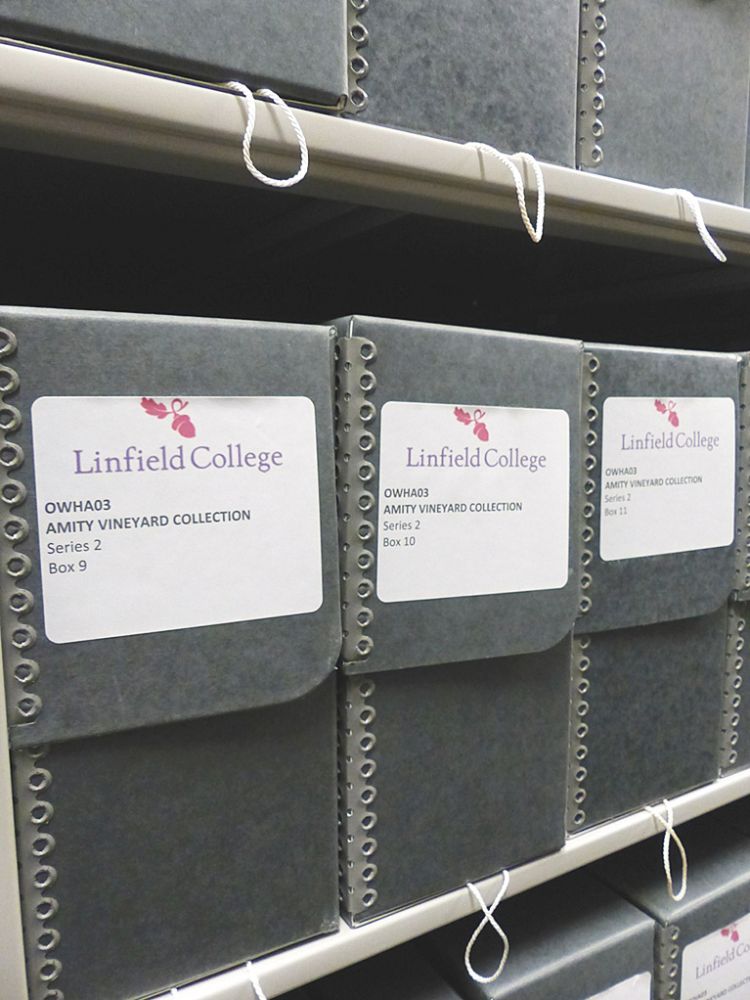
At Linfield University’s Oregon Wine History Archive, the understanding shapes everything. The archive was built on a simple premise: the story of Oregon wine could not be preserved solely through objects. Most archives choose a lane, collecting books, documents or artifacts. Useful, certainly. Necessary, even. Yet, incomplete.
As director Rich Schmidt explains, none of those approaches fully conveyed what needed to be saved. “We thought all of those should be a part of what we’re doing,” he notes. “But none were quite enough.”
So, the archive followed a different path.
“We’re collecting stories.”
THE WORK OF LISTENING
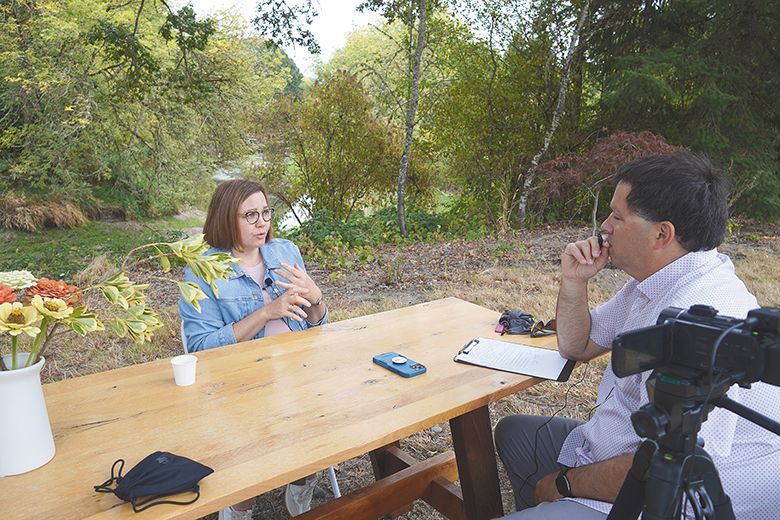
The heart of this archive is not what it holds, but how it listens. Its oral histories are not traditional interviews but long-form conversations, designed to invite reflection rather than extract information. A life is not reduced to highlights. It unfolds.
“My goal is to ask five questions and get an hour and a half of answers,” Schmidt explains.
There is structure and preparation. But once the conversation begins, something shifts.
“How often in your life does someone ask you to tell your story– and then truly listen?”
People remember things they have not thought of in years. They connect moments that had never been positioned side by side. The story deepens– not only for the listener, but for the person telling it. What emerges is not merely a record of events, but of perspective, tone and personality. How a life is understood from within.
Oregon wine is young. Much of its history is still within living memory. The earliest interviews date to 2004, with the conversational style beginning in 2013. Most material– documents, photographs, early records– reaches back only to the 1960s, when the modern industry began to take shape. There are a few older artifacts, even bottles from the early 1900s, but they are rare. What exists in abundance, still, are the people. But that window will not remain open indefinitely.
BEFORE IT DISAPPEARS
The archive itself emerged from a moment of quiet urgency. Starting in the late 2000s, as Oregon wine gained recognition, leadership was shifting and families were reorganizing as the founders stepped down. Physical records, often stored informally, were at risk of being discarded in the natural process of transition– not intentionally discarded, simply not carried forward.
Meanwhile, interest in Oregon wine was growing. Writers, researchers, filmmakers and students were asking questions the industry wasn’t equipped to answer. Each winery and family held pieces of the story, but there was no central site where everything could be preserved, accessed or understood together. The archive became that place– not to control the narrative, but to preserve it.
In March, Schmidt traveled through Southern Oregon, conducting 19 interviews with members of the regional wine community, now preserved on the Oregon Wine History Archive website and podcast. What follows are some of those voices.
“All stories are important,” Schmidt observes. “And they all feed into the larger story.”
AN INDUSTRY, CULTURE AND LIFE
Across these conversations, something both expected and surprising emerges. “It is an industry, yes,” Schmidt shares. “But wine is also a culture and lifestyle here.”
What people describe, again and again, is not just a profession, but a way of life– a convergence of land, labor, hospitality and community. Many arrive from conventional careers and find something far more meaningful.
For Carole Skeeters-Stevens of Ryan Rose Wine– who holds a master’s degree in Agricultural Education and serves as chief marketing officer for Travel Medford– that understanding is both practical and personal. “Nothing adds value like taking a grape and turning it into a $50 bottle of wine,” she asserts. “It’s an incredibly rewarding industry to work in. It’s about wine, but even more about the broader culture united by wine.”
BUILDING THE CULTURE, ONE VINTAGE AT A TIME
In the Applegate Valley, this culture has been shaped over a quarter-century. Cal and Judy Schmidt, founders of Schmidt Family Vineyards, unrelated to archive director Rich Schmidt, were among the early voices defining both the wines and region’s expectations.
Cal remembers a time when quality was not assumed but developed collectively. “Early on, we pushed for increased wine quality,” he recalls. “People brought both good and bad wines to our meetings, and we’d all learn. Wine quality has always been a big deal here because it’s the hardest hurdle to overcome. But we’ve done it.” He also helped establish the original World of Wine festival to introduce Rogue Valley wines to a broader audience.
Progress, like the wines themselves, required patience. “Wine takes time,” Cal adds. “And each vintage is unique, keeping wine interesting.”
For Judy, the result is not just better wine, but a particular kind of place. “We are very community-oriented,” she shares. “We try to be top-notch without being a snooty winery. We love hosting dogs and kids.”
A REGION IN ITS GROWTH PHASE
Across Southern Oregon and the Rogue Valley, that sense of becoming is still palpable. As Andy Myer, founder of Goldback Wines, describes it, “I think of wine regions in three stages: ‘Pioneer,’ ‘Entrepreneurial or Growth’ and ‘Big Money.’” The Rogue Valley sits firmly in the second– dynamic, expanding, and still defining itself with energy, momentum, and a shared sense of both possibility and responsibility.
LIVING THE WORK
For Rob Folin, winemaker at Belle Fiore Winery and co-owner of Ryan Rose Wine with Skeeter-Stevens, that evolution is both craft and calling. “You make wine once a year, so it takes a while to gain experience,” he notes. “The details are crucial while crafting wine. They add up.” Something else takes hold, too. “It’s a lifestyle,” he continues. “And it becomes incurable.”
Paula Bandy and her dachshund, Copperiño, are often seen at Rogue Valley’s finest wineries, working to solve the world’s problems. She has covered wine, lifestyle, food and home in numerous publications and academic work in national and international journals. For a decade, she was an essayist/on-air commentator and writer for Jefferson Public Radio, Southern Oregon University’s NPR affiliate. Most recently, she penned The Wine Stream, a bi-weekly wine column for the Rogue Valley Times. Paula believes wine, like beauty, can save the world. She’s also a Certified Sherry Wine Specialist and currently sits on the Board for Rogue Valley Vintners. @_paulabandy