Small Seeds Become Ancient Trees
Oregon wine country joins the effort to save the disappearing Oregon white oak
By Branden Andersen
You’ve almost certainly driven past this tree without realizing it.
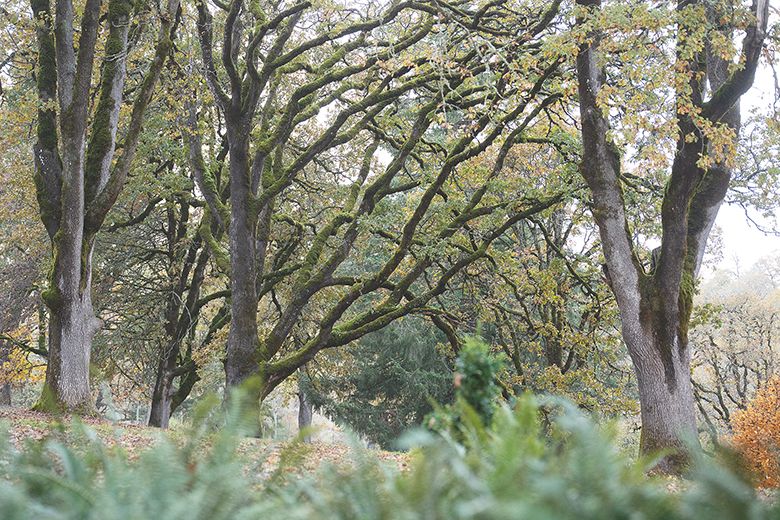
To most, it looks like a standard shade tree, usually standing alone in the middle of a field or at the edge of a vineyard. Its bark is deeply furrowed, limbs gnarled and canopy– in advanced age– as wide as a farmhouse.
If the tree is old enough, it stood when Lewis and Clark explored the Willamette Valley. Its acorns fed the local Kalapuya people long before a single grapevine was intentionally planted in Oregon soil.
It is Quercus garryana– the Oregon white oak– and is rapidly disappearing.
According to the Clackamas Soil and Water Conservation District, a mere 10 percent of the oak habitats present in 1850 still remain. And 96 percent of what’s left stand on private land. The Umpqua Watersheds organization puts the loss in starker terms: estimates of remaining oak ecosystems across the Pacific Northwest range from just five to 15 percent of their pre-European settlement extent, with less than one percent protected in parks or reserves.
A tree that shaped the Willamette Valley’s ecology for millennia is edging toward extinction– not through any deliberate act, but from what conservation advocates call “benign neglect.” The land around the tree is usually worth more than the tree itself.
Now, a growing coalition of winegrowers, students and sustainability advocates is working to reverse that decline.
A PARTNERSHIP TAKES ROOT
Growing Oaks began in 2020, founded by environmental studies students who had learned the Oregon white oak was a keystone species
LIVE director Chris Serra reached out after reading a newspaper article about the student group. The students partnered with LIVE, the Pacific Northwest’s largest sustainable winegrowing certification, covering more than 25 percent of Oregon’s vineyards.
Serra worked with an outside firm to calculate how many trees– grown over 50 years– would be needed to sequester enough carbon to offset the Oregon wine industry’s average annual carbon footprint, as measured in 2020.
The answer was 11,000. Together, the two organizations set about achieving this bold goal.
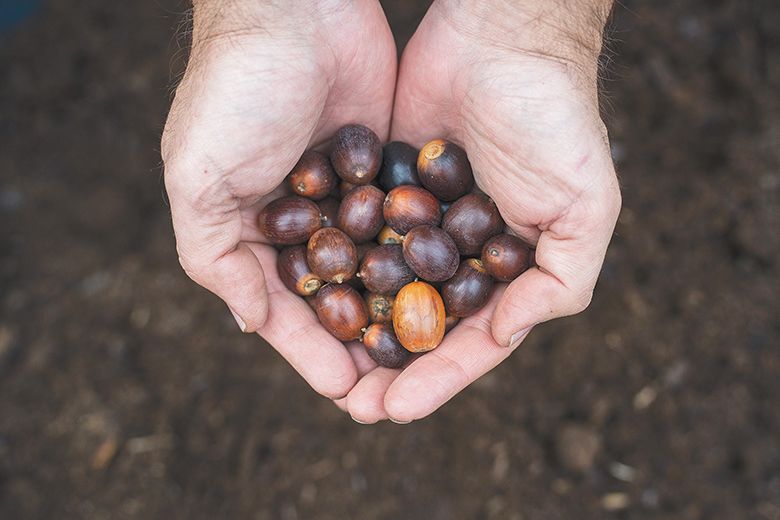
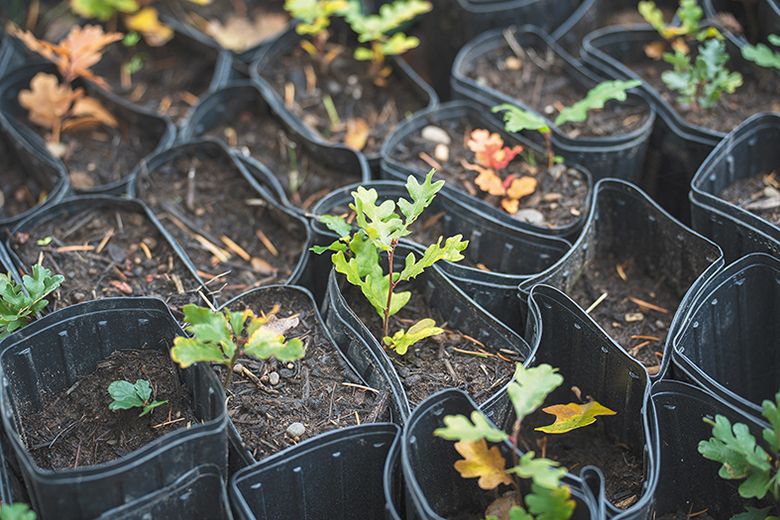
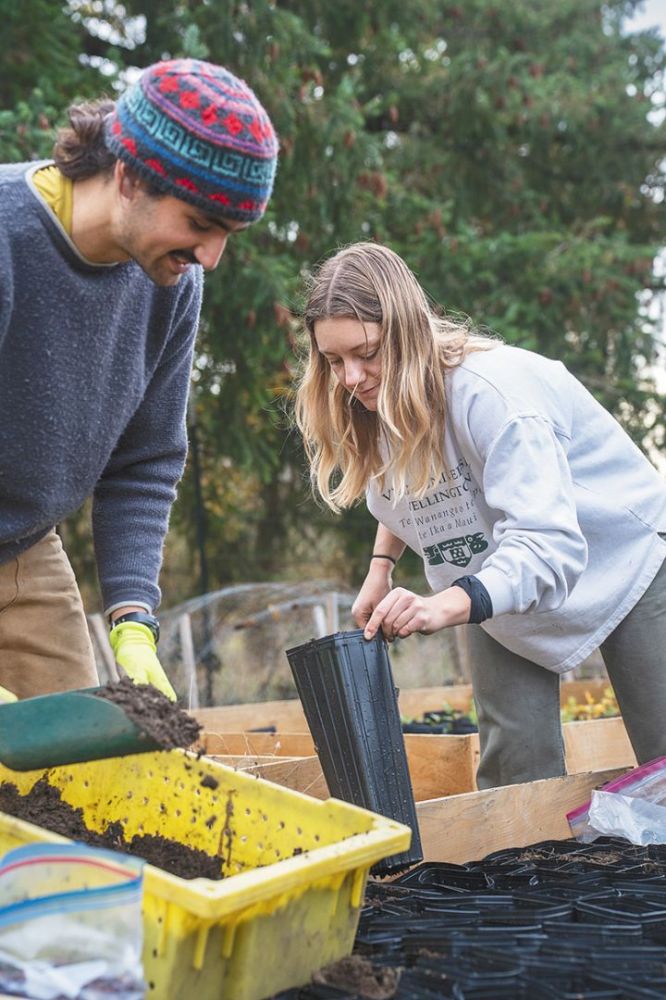
“Between 2024 and 2025, we planted about 6,000 trees in pots,” shared Isabelle Tobe, LIVE’s communications coordinator.
The operation is entirely donation-funded– all the soil, wood, greenhouse materials and acorns are donated. A donated greenhouse, provided by Stirling Fox, owner of Stirling Wine Grapes, Tobe noted, changed everything.
“I feel like we might hit our 11,000 goal this year, if we have enough acorns.”
Saplings are distributed to a variety of organizations, from the Confederated Tribes of Grand Ronde to regional soil and water conservation districts and LIVE members.
A NATURAL CONNECTION
Oaks and grapevines enjoy the same terrain: well-drained, sun-exposed hillsides with soils that dry out in summer. An expansive oak savanna previously covered the Dundee Hills. Many Oregon vineyards were planted where oaks once stood.
“There’s perhaps a sense of responsibility,” Tobe explained. “Many winegrowers tore down oak tree populations to plant vineyards.”
But the relationship isn’t only about reparation. LIVE’s certification program requires member vineyards to set aside at least five percent of their total acreage as “ecological infrastructure”– untreated land that promotes biodiversity.
Most members, she added, significantly exceed that threshold. The oak fits naturally into those spaces, and its presence influences the entire farm system.
Oregon white oaks can support several hundred insect species, including leafhoppers, parasitic wasps and beneficial beetles. These native insects help control vineyard pests such as mealybugs and aphids, while also supporting defenses against fungal diseases like powdery mildew.
Regional oak habitats provide food, shelter and nesting areas for more than 200 species of birds, amphibians, reptiles and mammals. Birds, attracted to oak habitat, help keep vole and rodent populations in check.
As a food source, its acorns, rich in protein and fat, sustain deer, squirrels, dark-eyed juncos, wild turkeys, acorn woodpeckers and band-tailed pigeons. As a habitat, the tree’s deeply furrowed bark shelters lizards, roosting bats and small birds. Holes in older limbs provide nesting sites for cavity-dependent species, including woodpeckers, white-breasted nuthatches and Western gray squirrels (listed as endangered in Washington and sensitive in Oregon).
Healthy mycorrhizal fungi, disrupted by some modern farming practices like tilling, are stimulated by oak root systems, strengthening the soil web on which vines depend.
“The more native species you have, the stronger your soil health,” Tobe reported. “A lot of people come to properties that were previously tilled and really have to rebuild the soil.”
A single native oak in the middle of a field has tremendous value to songbirds and other wildlife, according to the Clackamas Soil and Water Conservation District. And these trees are, in the truest sense, irreplaceable on any human timescale.
Oregon white oaks can live 500 years, according to Oregon State University’s forestry research. They grow slowly– less than a foot per year in most conditions. Regrowing an oak woodland from scratch takes 100 to 200 years.
And nowhere does this old Greek proverb ring truer: “A society grows great when old men plant trees whose shade they know they shall never sit in.”
A LEGACY OF SOIL
Oregon’s sustainable wine community discusses stewardship in terms of what is left behind for the next vintage, generation and century.
“Everyone in the LIVE program becomes a steward of the land,” Tobe shared. “To preserve wonderful land for years to come, for their children and grandchildren. That’s a role the wine growers can play… a soil legacy.”
Trees planted today, if they take hold and are protected, will remain standing long after everyone alive today is gone. They provide shelter for species whose names most people don’t know. They sequester carbon, stabilize slopes, cool streams and supply food– in a chain of energy running from acorn to hawk– the living world surrounding them.
The Oregon white oak has been doing this for millennia. All it needs now is a little help getting started again.
Growing Oaks hosts several volunteer collection and planting days each year, typically between September and February. Get involved by attending a volunteer planting day, donating supplies– soil, wood, chicken wire or Oregon white acorns harvested from their property– or simply visiting growing-oaks.wixsite.com to learn more. Vineyards interested in planting Oregon white oaks should email LIVE: isabelle@livecertified.org.
Want to learn more? The Pacific Northwest Oak Alliance and its partners, the Willamette Valley Oak & Prairie Cooperative and the Umpqua Oak Partnership, offer resources and a regional community at oakalliance.org. The Alliance’s ongoing Decade of the Oak campaign is a call to action for anyone– landowner, educator or wine lover– to become an oak steward.
Branden Andersen is the founder and publisher of Newsberg, an independent, community-focused news outlet serving Newberg and Dundee. As a reporter in Oregon’s wine country, he regularly covers the people and places that shape the Willamette Valley wine industry. Learn more at newsberg.org.