
Putting Down Roots
Satyr Fire opens new tasting room in Dayton
By Ron Scott
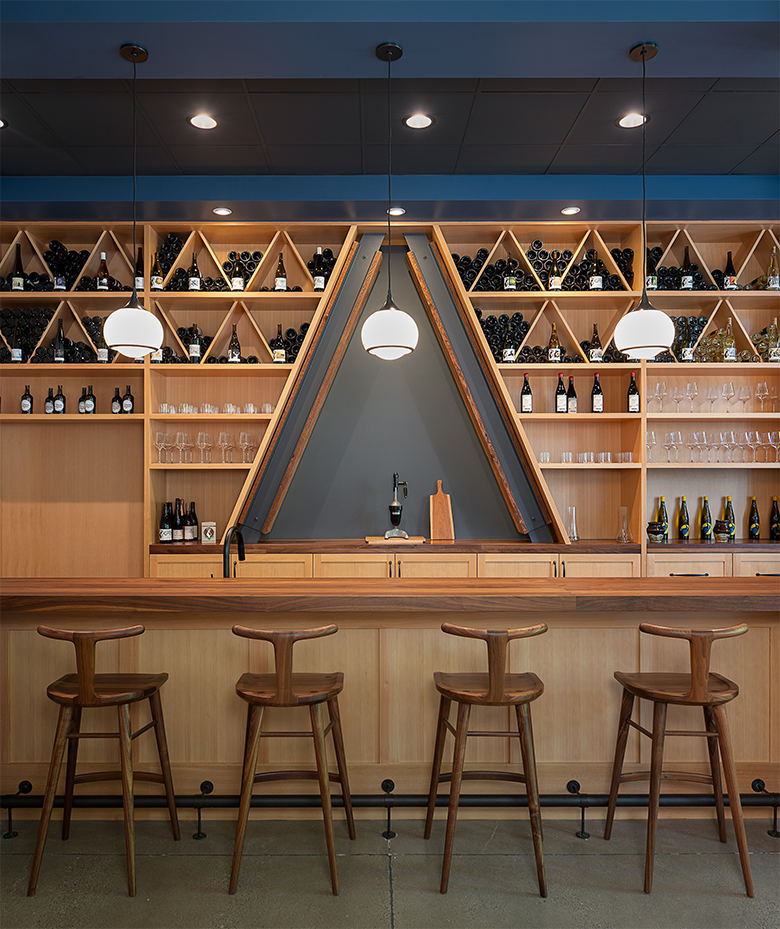
A sliding library ladder runs along the back bar at Satyr Fire’s new Dayton wine lounge. On another wall hang framed originals of the drawings used on the winery’s labels.
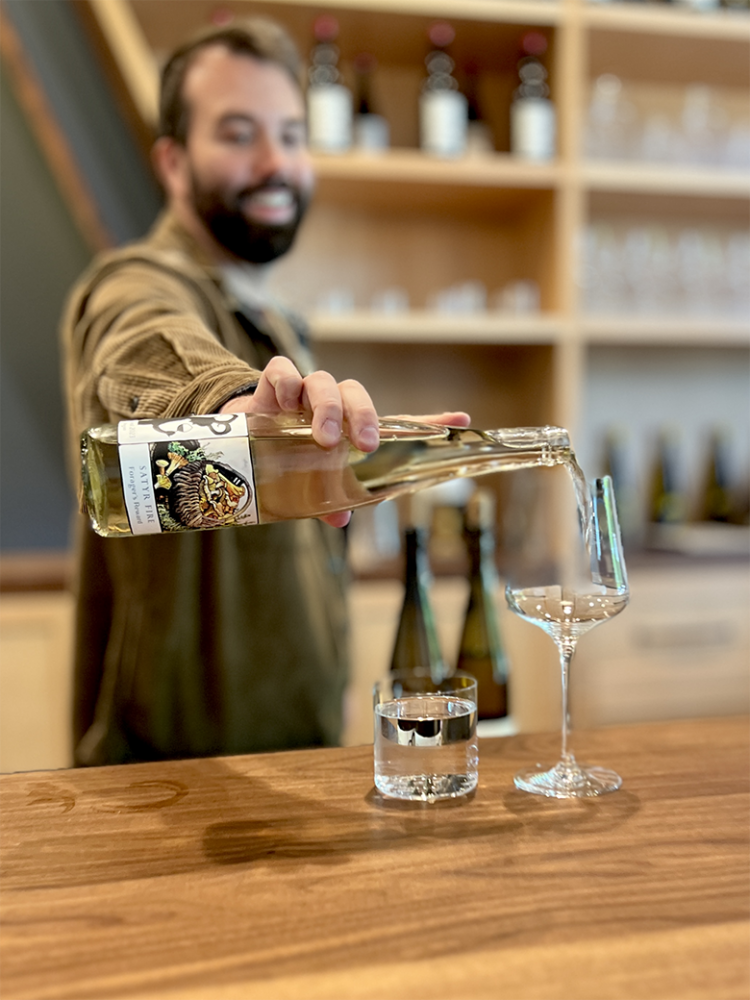
Owner Paul Johnson draws every label and writes a short story for each new wine, adding characters and episodes to a fantasy realm that has grown alongside the winery. Members may forget a wine’s proper name, he admits, instead asking for “the moth wine” or “the one with the red panda.”
He speaks in lengthy, polished bursts, racing through one fully formed thought because another is already queued up. The wines, drawings, stories and tasting room were all planned, studied and carefully assembled– little about Satyr Fire has been done in haste.
Johnson wants returning customers to feel the same anticipation as a kid walking into a comic-book shop and spotting a new issue in a favorite series.
“When somebody who loves Satyr Fire sees a bottle with a label they haven’t seen before, I want to ignite that same thing,” Johnson shares. “‘I haven’t tried that one yet.’”
Until this summer, however, Satyr Fire’s world had no permanent home. Johnson poured wine at festivals and pop-ups, welcomed customers into the cellar and sometimes sold bottles from the back of his car. These “nomad years,” a period of constant travel, taught him patience, hard work and humility.
Johnson paired the June grand opening with a wine club pickup party, bringing an established customer base through the doors from the outset. Roughly 300 people visited over two days for wine, salmon crudo, Dungeness crab and ricotta dip, and maple-glazed fried chicken served with sweet Riesling.
“It was just revelry,” he recalls. “It was fun, joy, celebration.”
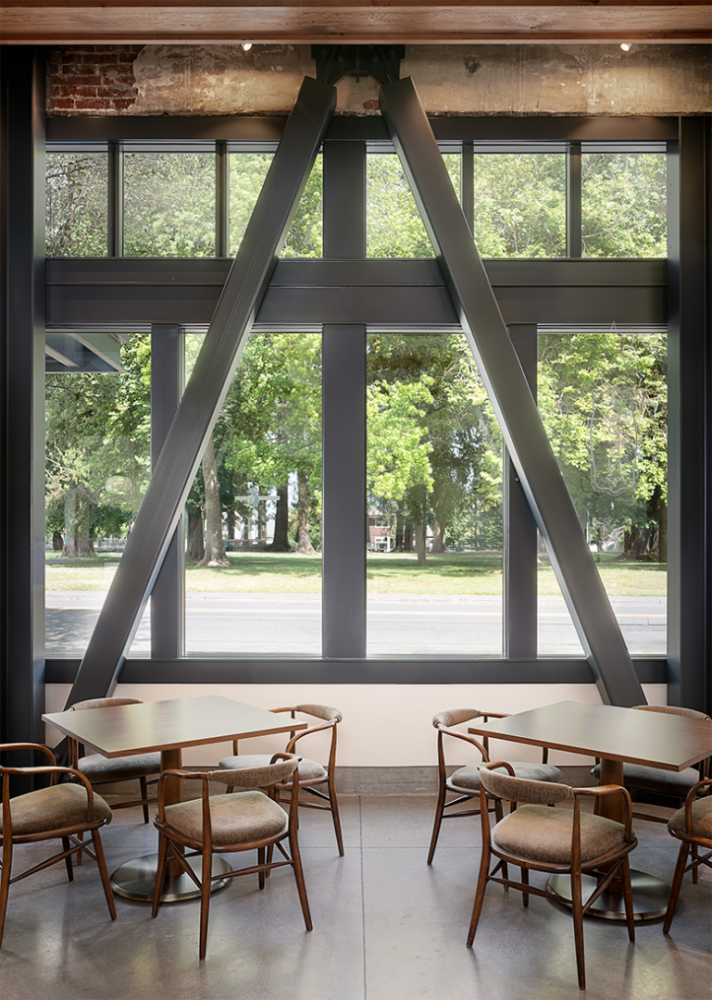
Satyr Fire’s contemporary build-out occupies a brick building dating to 1911, overlooking the Dayton Green. Johnson’s home is less than a mile away. He can walk or bike to work; a playground sits across
the street.
As luck would have it, Johnson, wife Barbara Rose Romaine and their son were eating lunch at LOAM when they noticed a for-lease sign next door. “We’ve dreamed of this moment, of having our own space, for such a long time,” he confesses.
After moving from Connecticut to Oregon in 2015, the couple spent two years exploring the Northern Willamette Valley before settling in Dayton. Johnson appreciated the historic small town’s proximity to McMinnville, Carlton, Dundee and the Eola-Amity Hills, as well as its quieter and more rural character.
“We get to carve out our little piece and become one of the voices influencing what it’s becoming,” Johnson adds. “We’re betting on the future.”
That wager depends heavily on direct sales. Satyr Fire has no wholesale distribution, relying instead on its wine club and tasting room customers. The new space provides a steadier sales channel as Johnson raises production from roughly 1,200 cases to an anticipated 1,500.
It also allows him more room to experiment.
Johnson plans to work with six new varieties to Satyr Fire this vintage: Pinot Meunier, Trousseau Noir, Gamay Noir, Cabernet Franc, Godello, and Sauvignon Blanc. They join a portfolio centered on Riesling, Chardonnay, Chenin Blanc and less common whites– Auxerrois and Gewürztraminer– alongside Pinot Noir, sparkling and fortified wines.
Sourced from vineyards across Oregon, Satyr Fire’s production takes place at Trisaetum Winery on nearby Ribbon Ridge.
This proclivity toward variation predates his winemaking career. Johnson grew up in Connecticut, where his mother worked as a restaurant wine buyer. At home, he notes, wine was “treated by my family as something regal and prestigious, as if it were art and a part of culture.”
After earning a degree in literature and creative writing with a minor in fine art, Johnson struggled to support himself through writing, copyediting, and artwork. His mother helped him land a job as a beer buyer at a high-end bottle shop, where he traveled the Eastern Seaboard securing limited-release cans and bottles. Invited into weekly wine tastings by the shop’s general manager, he eventually became wine buyer– and, with access to the New York import market, tasted thousands of wines a year.
Despite immersion in powerful reds from Napa, Bordeaux and Australia, he eventually returned with confidence to what had first captivated him: Sancerre, Riesling and other aromatic, acid-driven whites.
One mentor offered some practical advice: “Make wines you like. That way, if nobody buys them, you have at least one customer.” Johnson took it to heart– and has found considerably more than one. The less conventional Satyr Fire’s portfolio has become, he observes, the greater the response from consumers.
“A big part of my mission is showing off the diversity of white wine from the Willamette Valley,” he acknowledges. “I think Oregon can emerge as one of the great Riesling regions in the world.”
Riesling remains his “desert-island wine,” the variety he believes best represents Satyr Fire. He points to the dry Stargazer Riesling, served at Local Ocean Seafoods in Newport, and imagines it beside oysters, rockfish tacos and Dungeness crab cakes while sea lions bark outside.
Chenin Blanc joined the fray less intentionally. In 2020, Johnson visited a Columbia Gorge vineyard to collect Gewürztraminer grapes. The grower had harvested more Chenin Blanc than another buyer would accept so he offered Johnson the excess.
“Throw it in the truck,” he heard himself say.
During fermentation, the Chenin Blanc’s energy, tension and brightness convinced him to make the grape forever. Johnson returns to that vineyard each year; a 100-case lot of traditional-method sparkling Chenin Blanc now ages en tirage.
Depending on chemistry and inspiration each year, the Chenin Blanc might become dry, sweet or sparkling, fermented in stainless steel or aged in barrel.
That adaptability suits a winemaker with no desire to produce the same wines ad nauseam.
Years in retail also instilled in him the importance of listening. Each customer arrived with specific reasons for buying wine, be it taste, budget or meal pairing. Successful service required understanding the person and the motive before recommending the bottle.
That same philosophy informs the Dayton lounge. Glass pours range from $8 to $15, with sangria, mimosas and porto tónicos available alongside traditional flights. Satyr Fire stays open until 9 p.m., allowing wine-industry workers to stop in after work and nearby hotel guests to finish an evening with a nightcap.
Johnson has no ambition to turn Satyr Fire into a restaurant. He offers charcuterie boards but also encourages guests to patronize neighboring restaurants before or after stopping in for a glass. Takeout is welcome, too; guests can bring in dinner and let Johnson recommend the pairing.
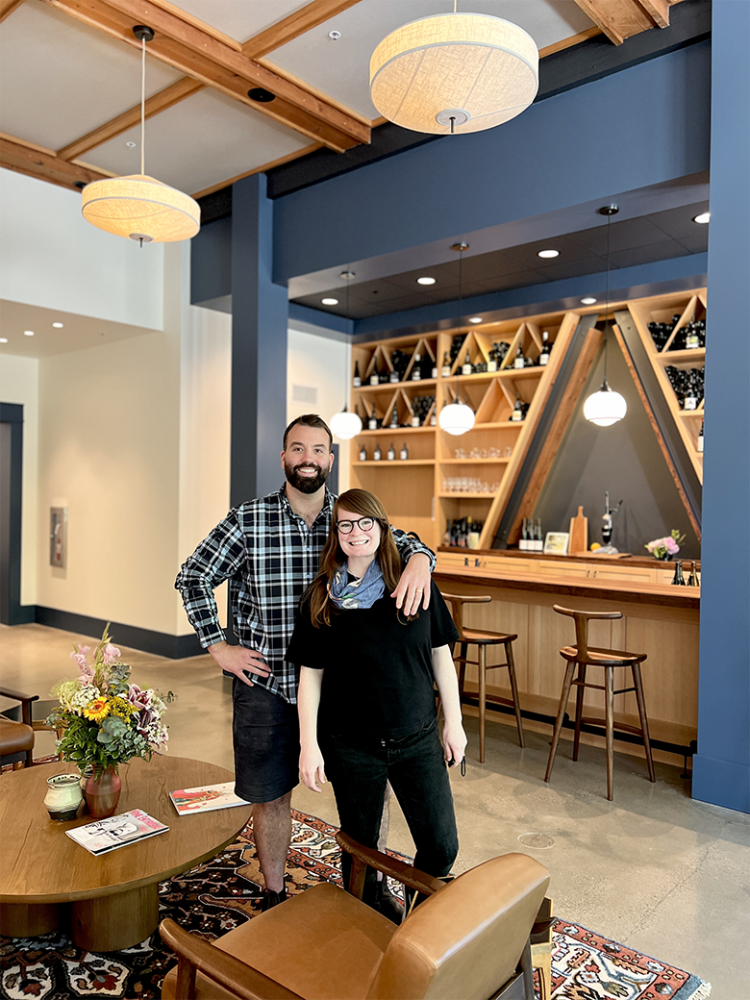
Romaine’s aesthetic shaped the tasting room space. Her background spans furniture sales, vintage design and fabrication, including work with Portland’s The Good Mod and Bend furniture maker Fernweh Woodworking. She selected the mix of vintage and contemporary furnishings and determined a layout Johnson would never have envisioned himself.
“She had an influence on the look of this whole place,” he asserts. “This was really curated by her.”
The result pairs a walnut bar and polished custom casework with lounge seating intended to recall a comfortable living room. Johnson wants the tasting room to feel polished without obscuring Satyr Fire’s more eclectic, creative ethos.
The interplay of wine, art and storytelling is Satyr Fire’s raison d’être. Each new bottling has its own drawing and companion story, which Johnson sends to club members upon release. Some of the fiction refracts the wine’s own circumstances: “Legacy of Myr” turns a smoke-threatened vintage into fantasy, while “Nectar Craft” follows two barrel thieves who repeatedly lighten their stolen load by drinking from it. Other stories push farther into Satyr Fire’s expanding mythology. “Mïruvör Türyandę” moves from maritime mischief to murder, while “Caged Sun” follows a captive girl who reclaims her stolen power and destroys the cloister that imprisoned her.
The stories are not promotional afterthoughts; they are integral to production. A wine is not finished until its drawing and story are complete. That sometimes means putting his son to bed and working until 1 a.m. as printing and federal label-approval deadlines loom.
At 38, with a family and a growing business, Johnson doubts he would maintain an art or fiction practice without those self-imposed requirements. With Satyr Fire, his roles as winemaker, artist and writer all work together.
In Dayton, the bottles, drawings, stories and people who have followed the project finally share one room.
The nomad has finally built a home.
Satyr Fire
304B Ferry St., Dayton
Open Thurs. & Mon., noon to 6 p.m.
Fri., Sat. & Sun., 11 a.m. to 9 p.m.
(203) 560-8599
Ron Scott is a Portland-based writer and photographer covering food, wine, beer and spirits across Oregon and the Pacific Northwest. His work has appeared in Portland Monthly, Eater Portland, Sip Magazine and Willamette Week. He is passionate about regional food and beverage as well as hospitality, especially the operational details wherein sourcing, setting and service shape the guest experience.