
Marking the Trail
Student-built project connects community, craft and wine country
By Paula Bandy
The Applegate Valley mirrors the winding Applegate River, a tributary of the Rogue, flowing through Southern Oregon’s Siskiyou Mountains. Stretching roughly 50 miles from the California border to its confluence near Grants Pass, the Valley moves in gentle bends– oak-studded hills give way to vineyard rows, forested spaces open to pasture land. Long before the vines, this corridor was shaped by water, wildlife and the presence of Indigenous people; later, by gold seekers tracing the river upstream. Today, the Applegate Valley American Viticultural Area, or AVA, is where elevation, aspect and the river’s moderating influence create one of Oregon’s most diverse growing environments.
The idea for new, unified signage began not with a formal directive, but during a membership brainstorming meeting of the Applegate Valley Vintners.
“Our vision? Every winery would have the same sign,” recalls Rachael Martin, founder and winemaker of Red Lily Vineyards. “It denotes– hey, you are in the central hub of Applegate wine country.”
What followed was not a quick production cycle, but a collaborative effort extending beyond the wine community itself.
Martin has an established relationship with Eagle Point High School, where the Career Technical Education program provides students access to advanced labs in design, fabrication and engineering. She proposed a partnership: students would design and build the signs as part of their coursework, giving them real-world experience while creating a unified identity for the Valley.
Instruction & Leadership
At the center of the program is Eagle Point High School instructor Daniel Langston. He oversees the school’s wood shop, metal shop and integrated design labs, as well as its participation in SkillsUSA, a national program that prepares students for careers in technical and skilled fields.
Student teams, led by Langston, compete at both state and national levels in disciplines ranging from robotics and computer design to metalwork and fabrication– incorporating technical skill with real-world applications.
Langston was key to the signage project’s success. “He’s an absolute champion for opportunities for his kids,” Martin boasts. “It takes a dynamic person to create that kind of energy.”
The program blends digital design with actual production. Students develop concepts in a computer lab before moving into the adjacent wood and metal shops to produce them. “It’s not just learning in a classroom,” she notes. “They’re doing the full process– designing, building, problem-solving– and creating something that will be part of this Valley for years.”
She pauses, then laughs. “It feels a lot different than the napkin holder I made in woodshop.”
Martin adds, “The future is very hopeful if you spend any amount of time in that lab. I can’t think of another word but inspiring.”
From Concept to Completion
The sign project took nearly two years of design and fabrication. Students developed digital renderings, produced multiple mockups and worked through iterative refinements with feedback from the Applegate Valley Vintners Association members.
“We went through a lot of versions,” Martin explains. “Patina, font and scale before figuring out what felt right for the Valley.”
The double-sided signs– one for each member winery– are designed to be both functional and reflective of place.
Oregon’s Wine Country License Plate program, administered by Travel Oregon, supplied funding for the project. Revenue from specialty plates is reinvested into grants that support wine tourism, marketing and regional development across the state. In this case, the grant funded raw materials, while student labor was incorporated as part of their hands-on learning experience. “We applied for the grant to cover the materials,” Martin observes. “The metal, the wood framing– and installation, if needed. It’s a relatively small amount of money for a pretty big result.”
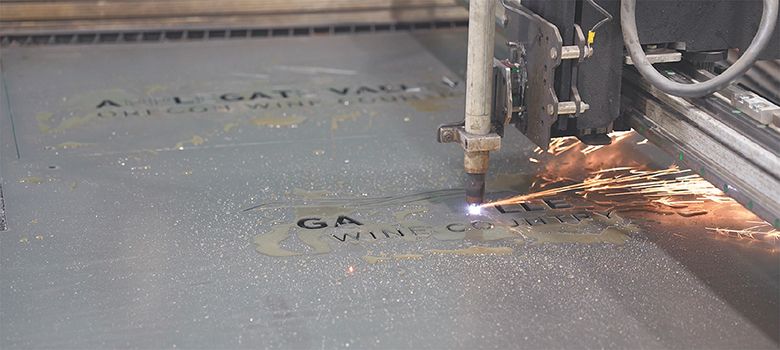
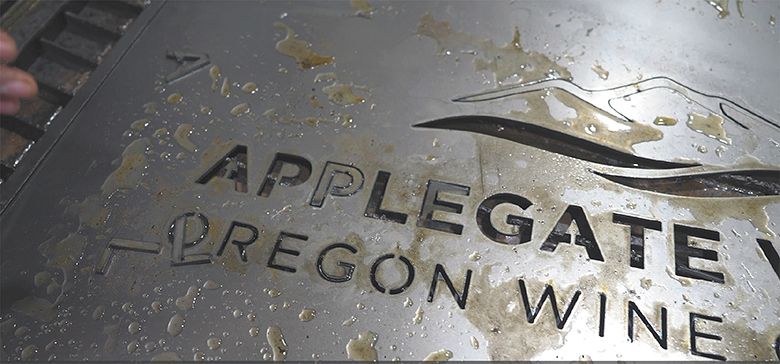
Each sign measures approximately three by five feet and is fabricated using a laser plasma cutter at Eagle Point High School. The metal surface is designed to weather over time. “It will develop this really beautiful, rusted look,” Martin adds. “It fits the aesthetic of the Applegate Valley.”
A clear acrylic panel allows light to pass through the center, increasing visibility from both directions, while a simple wood frame provides structure. Even the mounting brackets were fabricated by students, using leftover material from the cutting process. The signs read: “Applegate Valley, Oregon Wine Country,” anchored by the AVA’s mountain-inspired logo.
The first sign will be unveiled on May 17, 1 p.m. at Red Lily Vineyards, with students, educators and members of the Applegate Valley Vintners gathering to celebrate the project. Rather than a single-entry marker, the new signage will be distributed throughout the Valley, each winery placing its sign in a highly visible location. “It’s kind of like following the trail,” Martin reports. “When you see the signs, you know you’re on the right path.”
Learning in Real Time
For students involved in the project, the experience extends beyond fabrication. Sophomore Jason Devette, who worked on the signs, sees the project as a bridge between school and future work. “I want to go into engineering, and this is a really great opportunity,” he states. “You get to start your design work and take it all the way through the process. And when you’re commissioned to do something like this, it feels more like what it would be like working for a company.”
Devette, using programmed software, worked on the computer numerical control machine to precisely cut and shape materials. “We have a lot of students working on it,” he continues. “Some cutting, some assembling– it’s really cool to be part of this group. And to be able to say I helped make something like this.”
For Eagle Point High School principal Heather Marinucci, the project reflects a broader evolution in Career Technical Education. “Since about 2015, we’ve worked to take these programs to the next level,” she says. “The state has supported funding that allows us to invest in current technology.”
More importantly, she notes, students are gaining experience that mirrors real-world expectations. “It’s one thing to make your own projects,” she says. “But when you’re estimating costs, working through a commissioned project, and completing the full process– that’s invaluable.”
Back in the Applegate Valley, the signs will create a shared visual through the landscape.
For Martin, the project represents something beyond signage. “It’s a benefit to both sides,” she describes, “And something the whole community can be proud of.”
Along the bends of the Applegate River, the markers will appear one by one– consistent and unmistakable– serving as a reminder: you are on the Applegate Valley Wine Trail.
Applegate Valley Wine sign unveiling event
May 17, 1 p.m.
Red Lily Vineyards, 11777 OR-238, Jacksonville
Paula Bandy and her dachshund, Copperiño, are often seen at Rogue Valley’s finest wineries, working to solve the world’s problems. She has covered wine, lifestyle, food and home in numerous publications and academic work in national and international journals. For a decade, she was an essayist/on-air commentator and writer for Jefferson Public Radio, Southern Oregon University’s NPR affiliate. Most recently, she penned The Wine Stream, a bi-weekly wine column for the Rogue Valley Times. Paula believes wine, like beauty, can save the world. She’s also a Certified Sherry Wine Specialist and currently sits on the Board for Rogue Valley Vintners. @_paulabandy