Smoke Signals
New study determines the 2020 wildfires cost Oregon wineries long after the air cleared
By Michele Francisco
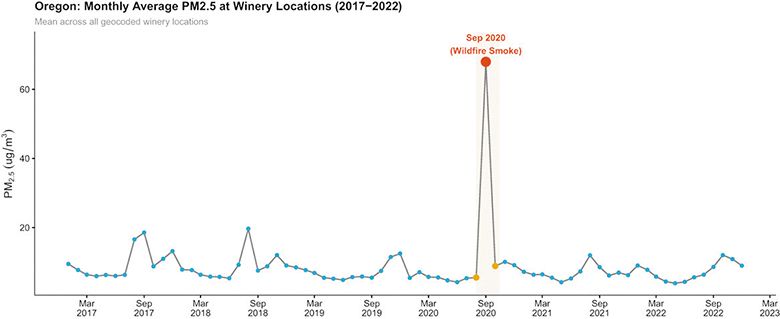
Obviously, 2020 conjures bad memories. The world was reeling from COVID-19, and wildfires were raging in Oregon as the wine grape harvest was getting underway. A recent study now confirms the economic toll of the Labor Day fires continued to ripple years after the smoke cleared.
Researchers at Oregon State University's Department of Applied Economics found that wineries exposed to more intense smoke in September 2020 sold less wine at retail for several years, with losses extending through 2023. Their report, “When Smoke Signals Economic Loss: How Wildfires Harm Oregon Wineries,” published Oct. 15 in the Journal of Wine Economics, also reveals how smoky air measurably reduced tasting room traffic in the months that followed.
Based on survey data cited in the paper, more than 60 percent of Oregon wineries reported being directly affected by smoke, rising to 76 percent in the Willamette Valley. An analysis conducted shortly after the fires put California’s wine industry losses at $3.7 billion. However, authors Amod Sugiyama and James Sterns don't think these snapshots can separate the smoke’s impact from other factors at play.
To study how wildfire smoke affected Oregon wine producers, the researchers combined satellite-based air-quality measures with sales data. They categorized 850 wineries by annual production totals and compared sales of 171 Oregon wineries in 2018-24 with their exposure to smoke in September 2020. The researchers also referenced a separate dataset that tracked the monthly performance of 158 tasting rooms. Let's look at that dataset first.
FEWER VISITORS, FEWER SALES
“Poor air quality may deter visitors from visiting wine country in the months immediately following a smoke event, directly reducing tasting room revenue and on-site sales.”
Using monthly aggregated data, they found that for each ZIP code, an increase in smokiness was associated with a 5.8 percent decrease in both sales and visits the following month. Other consumer sales dropped a mere 2.7 percent. The authors attribute this to online and phone orders being less sensitive to local air quality than in-person visits.
“The tasting room analysis captures a simpler mechanism, with smoky conditions directly discouraging in-person visits to wineries regardless of vintage quality.” The authors found decreased hospitality revenue lingers for months following a smoke exposure. With many wineries relying on direct-to-consumer sales, wildfires and the smoke they generate can have dire consequences to the bottom line.
A SLOW BURN AT RETAIL
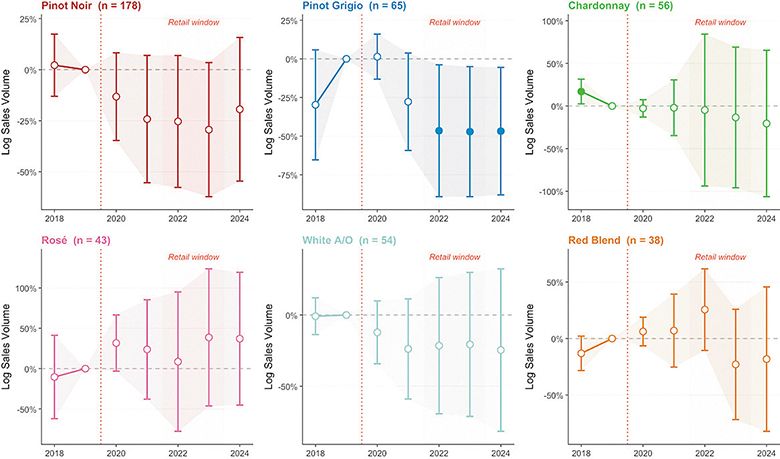
As time progressed, the retail damage became more apparent. During September 2020, a one-standard-deviation increase in smoke exposure (roughly 11.6 micrograms of fine particulate per cubic meter of air) was associated with retail sales volumes that fell roughly 15 percent in 2021, 20 percent in 2022 and 23 percent in 2023– all compared with 2019 baselines. The gap narrowed to about 19 percent in 2024.
The researchers say timing is consistent with the 2020 wines populating the retail market over two to three years. The peak effect hit in 2023, when the 2020 vintage was most prominent on store shelves.
“… Our results highlight a fundamental limitation of contemporaneous damage assessments: because the smoke impact on retail sales materializes two to three years after a smoke event, any economic impact evaluations that do not consider future impact could substantially underestimate the true economic cost.”
PINOT GRIS WAS HIT THE HARDEST
Not every variety faced the same fate. Pinot Gris suffered the steepest and most consistent sales declines, from about 24 percent in 2021 to 37-38 percent between 2022 and 2024. Pinot Noir– about 49 percent of retail sales in the sample– showed losses of roughly 21-25 percent through 2023, though the statistical evidence is slightly weaker. Together, the two varietals account for 75 percent of retail volume and nearly all of the overall decline. (Only the 2023 figure meets the most commonly used threshold for statistical significance; the 2021 and 2022 figures meet a slightly looser standard.)
Rosé, red blends and other white wines saw no significant effects. The authors suggest consumers might not strongly identify those types of wines with Oregon, thereby reducing any reputational damage after a smoke event. Chardonnay was excluded from the analysis because sales of the variety were already on a different trajectory before the fires, making it difficult to tease out the impacts of smoke from the existing trend.
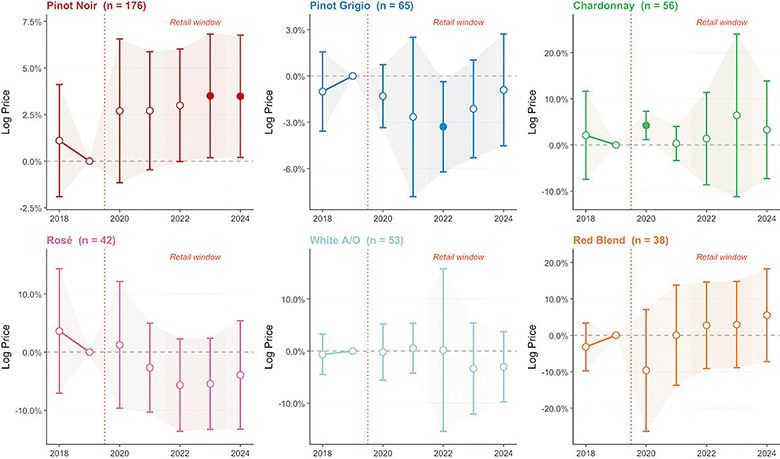
Prices told a more complicated story. Pinot Gris prices slipped about 3 percent alongside volumes. Pinot Noir prices rose by roughly 3 percent, even as sales volumes fell. The authors offer several possible explanations, but the paper doesn't directly answer the question of why the cost of Pinot increased.
BIGGER ISN’T BETTER
To assess if larger wineries with access to more sophisticated testing and equipment can alter the impact of smoke events, the researchers categorized 850 Oregon wineries into three groups: small (fewer than 5,000 cases), medium (5,000–10,000 cases), and large (more than 10,000 cases).
“We find no statistically meaningful difference in the smoke effect across size categories, suggesting that access to mitigation technology does not substantially buffer larger producers from the retail market consequences of smoke exposure.”
WHAT THE NUMBERS CAN'T SAY
The paper’s authors acknowledge several limitations in the study. Smoke exposure was assigned based on each winery's registered business address rather than its vineyard location, which could blur the picture. They believe this likely understates the true effect. The retail data doesn't identify which vintage was sold, so the link to 2020 grapes rests on timing. And the tasting room data is only one company’s anonymized clients, so the entire industry isn’t represented.
The study also doesn’t capture harm to Oregon’s collective reputation, which the authors note could magnify losses beyond what winery-level figures show.
The broader message of the completed research concerns timing. Damage assessments conducted in 2020 or 2021 would have missed the largest share of the retail losses. As wildfires grow more frequent across wine regions, multi-year tracking is needed to calculate the full cost.
For an industry that measures time in vintages, it's a fitting lesson. The consequences of a season can persist for years to follow.
Michele Francisco spent her childhood reading and writing, eventually graduating from UCLA with an English degree. She attended graphic design school and began a career in design and marketing. After moving to Oregon in 2010, Michele studied wine at Chemeketa Community College and began Winerabble, a Northwest-focused wine blog. She has been a cheerleader for Oregon wine since her arrival.