Sip Something Nouveau
Taste five Gamay Noir wines made with the same fruit
By Paula Bandy
Give five winemakers the same Gamay Noir grapes and apparently you get an accordion, Poison, Françoise Hardy, Carla Bruni– and one who would rather somebody else choose the music.
Welcome to Nouveau Gamay season in the Rogue Valley.
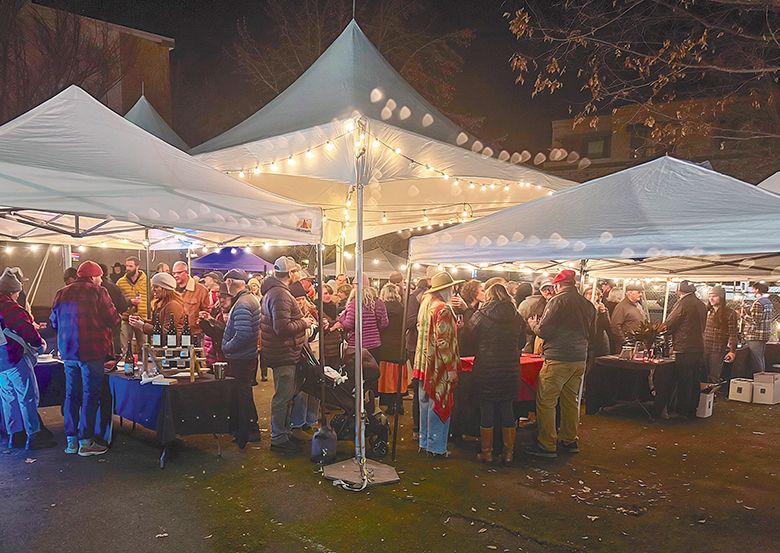
Nouveau Festival returns for its third year on Thursday, Nov. 19 from 4 to 7 p.m. Taking place at Resistance Wine Company, 323 N. Pioneer St., Ashland, winemaker Brian Gruber, representing Irvine & Roberts, is joined by Eric Weisinger of Weisinger Family Winery, Joe Chepolis of Sound & Vision Wine Co. and Rob Folin of Ryan Rose Wine. And Kimberly Drake, owner of Resistance Wine Co., joins the group this year.
The idea borrows from one of France’s most exuberant wine traditions. Beaujolais Nouveau, the young Gamay wine released soon after harvest, was first commercialized in 1951. Decades later, in 1985, the third Thursday of November was officially established as its release date, now celebrated worldwide as Beaujolais Nouveau Day. The tradition embraces the idea that wine doesn’t always need to age in a cellar. Sometimes it needs to revel in its youth.
Ashland has added its own twist.
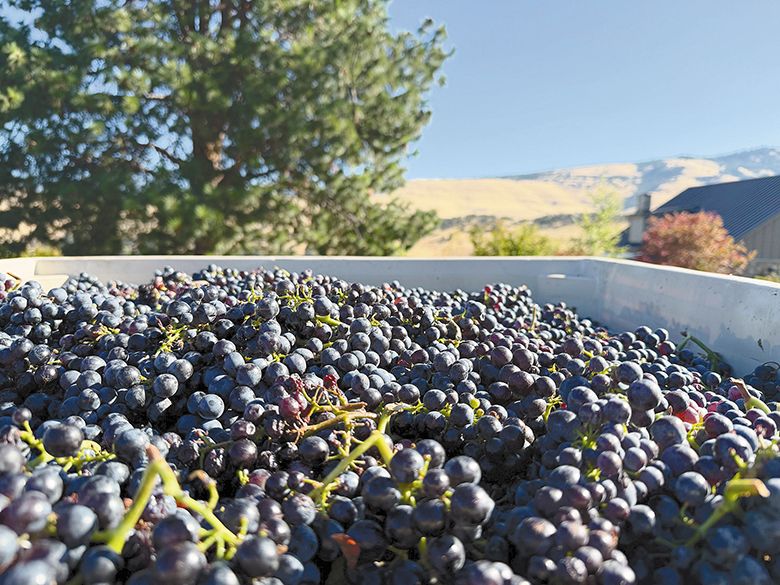
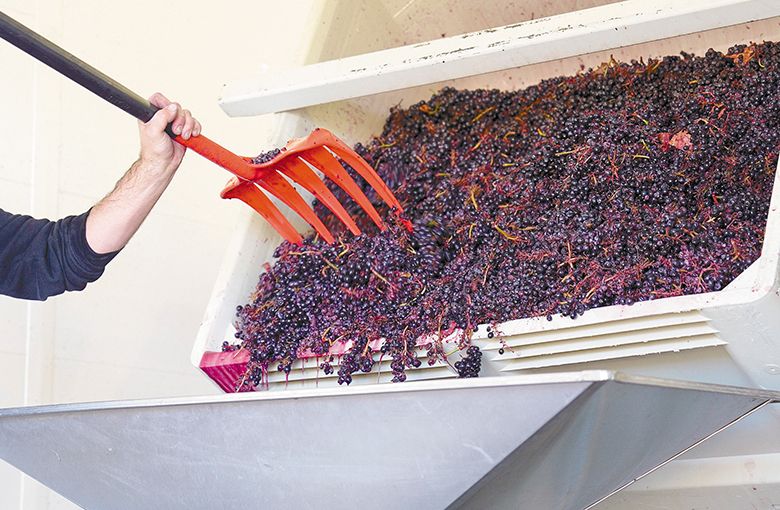
All Nouveau Festival winemakers begin with Gamay fruit grown at the Irvine & Roberts Vineyard in the Rogue Valley. The grapes are harvested at the same time. Then each winemaker takes over. Same grapes. Different hands. And as Gruber states, “We work together throughout the year but this offers an even deeper dive into collaboration.”
Carbonic maceration, the technique at the center of most Nouveau-style wines, causes fermentation within whole berries in a carbon dioxide-rich environment, accentuating freshness and bright fruit notes. In practice, these vintners make the process sound downright easy.
Weisinger begins responsibly enough. “The first thing I look at is the chemistry of the fruit: Brix, pH, acid,” he explains. He also checks the seeds, looking for indications of physiological ripeness.
Then he chucks the grapes in a bin.
“I dash in some dry ice, place a lid on the bin, give it some heat… then walk away for a week or so before checking on it.”
For Weisinger, it’s an exercise in letting go. Most wines require his attention every day early in the fermentation process. With Nouveau, he must trust what is happening beneath that lid. “One is never truly in control in winemaking anyway,” he acknowledges. “Nouveau makes that point abundantly clear.”
Folin has arrived at a similar conclusion. After deciding which fermentation vessel to use, once the carbonic process begins, restraint becomes part of the job. “If you sense things are looking good, then don’t touch it.”
Gruber also makes surprisingly few early decisions. He adds CO₂, covers the grapes well and tucks them out of the way. The important choice is where– temperature affects the fermentation and nudges the wine toward his intended result.
Chepolis pushes the hands-off philosophy even further. Last year he put the fruit into a sealed tank with “an unreasonable amount of dry ice,” and left it for two weeks. “I didn’t even think about it until everyone started texting about how they were pressing their grapes,” he recalls. “At that point I thought, ‘yeah, I should probably see what’s going on in there.’” He considered pushing the carbonic fermentation to three or four weeks, but “kind of chickened out.”
Those small choices– vessel, temperature, timing, when to press– are precisely when the wines begin separating from one another.
Chepolis stores his Nouveau in stainless steel to preserve tension and freshness. Some of the others have used neutral oak. “I wouldn’t do that for a wine like this,” he admits. “Oak makes it a little more intellectual, maybe. I keep mine in steel since I’m going for a party wine.”
Folin sees those differences as part of the fascination. “Minor changes in timing or temperature can produce very different wines.”
That is the point of pouring the bottles side by side: not to decide who got the wine “right,” but to taste what individual winemakers craft from identical fruit.
As winemaker at Irvine & Roberts, Gruber is more familiar with the fruit than anyone else in the group. Tasting the other wines hasn’t necessarily taught him more about the vineyard itself. Instead, he has learned how many excellent interpretations its fruit can produce. Yet, he asks, “How did they get that?”
After nearly 20 vintages, Gruber feels Nouveau offers him something increasingly rare: “an opportunity to learn something new… I can explore freshness and fruit in a wine, which Nouveau leans heavily into.” He makes two Gamays each year– Nouveau and a more structured, age-worthy wine. For Gruber, producing Nouveau reinforces how beautiful Gamay fruit can be, and he tries to capture more of that fruity freshness in the ageable version, while retaining its structure.
Drake enters this year’s project without any such history with Nouveau.
Why join now?
“FOMO, naturally,” she answers. “If Brian, Eric, Joe and Rob are doing it, it must be fun.”
Her first winemaking decision?
“First, I’ll listen to the bins of picked fruit, and find the one that speaks to me. Then I’ll break out my crystals.”
Pause.
“Just kidding!”
Whether to inoculate with commercial yeast, she notes, will probably be her first decision.
Drake has crafted wine alongside two of the other Nouveau winemakers and already knows something about how differently they approach their craft. Now she gets to see what happens when those styles meet what she calls a “Nouveau canvas.” Her Resistance version, she hopes, will express a shared spirit of adventure and a willingness to step outside the comfort zone “in the pursuit of fun and good wine.”
Or, as Drake puts it, “We’re always ‘DTF’– down to ferment!”
That pursuit of fun is not incidental to Nouveau. It may be the whole idea. “There is not– or at least there shouldn’t be– anything serious about these wines,” Chepolis confesses. Which is not the same thing as saying the winemaking doesn’t matter. Weisinger approaches it from another angle. “I take my winemaking seriously, but I’m just making wine.”
Somewhere between those two thoughts may be the particular charm of Nouveau: serious attention in the service of something deliberately unserious. And if there is a fruit dial, Chepolis seems inclined to turn it up to 11. His version is meant to be fruity, crushable and good with food– a party wine without apology.
Folin encountered another problem after making his first batch. “I wanted to drink it– not sell it.”
Weisinger is experiencing an evolution around all this apparent frivolity. People now stop and ask him if the Nouveau Festival will return in November. Culture develops over time, he shares, and one festival cannot create it alone. But celebrating the recent harvest, recognizing the end of a season, being thankful– and enjoying life– are all ways a wine culture takes root.
Which brings us back to the music.
Ask five winemakers what their Nouveau sounds like and the shared vineyard disappears completely.
Weisinger hears an accordion.
Folin goes straight to ’80s hair metal, specifically Poison: big hair, loud enough for “Nothin’ but a Good Time,” but with the softer power-ballad side of “Every Rose Has Its Thorn.”
Chepolis heads for 1960s France with Françoise Hardy and “Le temps de l’amour.”
Drake chooses Carla Bruni, who was born in Italy but mostly sings in French, Drake explains, and “it just sounds beautiful.”
“I’m not a Nouveau-style winemaker,” she adds, “but I’m hoping the Resistance take comes out with a pleasant accent.”
And Gruber?
“Pure, clean, fruity, easy to drink. A crowd-pleaser with enough complexity to keep things interesting.” He considers what song best captures the wine’s personality.
Then he punts.
“I’ll bet Joe of Sound & Vision has the perfect answer.”
Chepolis already does.
Turn up Françoise Hardy.
The Nouveau is ready.
Ashland Nouveau Festival
Thursday, Nov. 19, 4–7 p.m.
Resistance Wine Company
323 N. Pioneer St., Ashland
Tickets: $50, 21+ only
Paula Bandy and her dachshund, Copperiño, are often seen at Rogue Valley’s finest wineries, working to solve the world’s problems. As a columnist and writer, she’s covered wine, lifestyle, food and home in numerous publications and academic work in national and international journals. For a decade, she was an essayist/on-air commentator and writer for Jefferson Public Radio, Southern Oregon University’s NPR affiliate. Now full circle, she hosts a new wine podcast, Through the Wine Glass, featuring the stories behind wine and the people throughout the JPR listening area. Paula believes wine, like beauty, can save the world. She’s also a Certified Sherry Wine Specialist and currently sits on the Board for Rogue Valley Vintners. @_paulabandy