Growing Knowledge
The Willamette Valley WineGrowers Group has been sharing information since the 1970s
By Aakanksha Agarwal
In 2012, during the middle of harvest, Björnson Vineyard’s founder Mark Björnson was hauling eight tons of grapes toward McMinnville when his truck broke down.
It was about 70 degrees. The grapes needed to move. And Björnson, whose Eola-Amity Hills vineyard was only six years old, was panicking. He called Tim Ramey at Zenith Vineyard.
“Tim said, ‘I will be there in 12 minutes with my truck,’” Björnson recalls. “And I thought, who says 12 minutes?”
Björnson checked the time on his flip phone. “Sure enough, Tim pulls up exactly when he said he would arrive.”
They unhooked Björnson’s trailer, attached it to Ramey’s truck and Björnson took off. His father-in-law drove Ramey back home. “Without Tim’s help, I don’t know what might have happened,” he confesses. “It would have been a disaster.”
Back then, eight tons represented a significant portion of Björnson’s harvest.
“Being able to rely on your neighbors and friends is invaluable in this industry,” he reports.
HOW AN INFORMAL NETWORK STARTED
According to winegrower and longtime member David Beck, PhD, the earliest gatherings of the Willamette Valley WineGrowers Group– commonly shortened to WVWGG– date to the 1970s. Back then, the Valley had so few commercial winegrowers, nearly everyone could comfortably fit in a private home.
In those years, Beck observes, growers themselves knew best about what worked in Western Oregon vineyards. “They were the only real repository of information. Everyone wanted to share information and figure out what was going wrong or right in their vineyards.”
BEFORE THERE WAS A PLAYBOOK
Today, someone entering Oregon wine can turn to university researchers, consultants, trade organizations, viticulture programs, conferences and decades of accumulated regional knowledge.
“This was before the days of Chemeketa,” Beck describes of WVWGG’s beginnings.
As Chemeketa Community College’s wine studies program developed, the formal educational system and this network were intertwined. Beck remembers instructor Al MacDonald and others encouraging Chemeketa students to attend WineGrowers Group gatherings.
For Björnson and his wife Pattie, the timing was ideal. They acquired their land in February 2006 and planted the first seven acres that fall, while also joining WVWGG meetings.
“I was busy planting a vineyard while we were enrolled at Chemeketa,” Björnson states, “so I would pepper Al with about 400 questions every class. He was fairly patient with me.”
Björnson was nurturing young vines and wanted to know how much water they needed. MacDonald’s advice was straightforward: with the well-drained soils at his site, more water was better while the vines were young. “He told me, ‘You can’t hurt them by watering a lot,’” Björnson remembers.
Björnson followed MacDonald’s guidance. “One thing I really learned is to get young plants growing fast,” he notes. “Get as close to 100 percent survival as possible.”
WHAT WORRIED OREGON
Over the years, WVWGG members have discussed the history of the wine industry, its many changes and “how we can save the best parts.” They have addressed water concerns, growing the best possible fruit and what to do when clients don’t pay. As the climate changes, the group tackled new topics, including red blotch, spore trapping, mechanization, fungicide resistance and the use of glyphosate. Recent conversations involved fertilizers, crop insurance, the role of raptors and rodents, rootstock and immigration.
Beck has spent roughly the past decade as the group’s program chair, and his method for determining what belongs on that calendar is simple.
“Keep your ear to the ground and talk to people,” he responds. “What issues are really vexing us? What issues do we need to talk about? What new things are coming along that we need to be prepared for?”
“We have talked about a whole lot of technical, historical, as well as social kinds of things,” Beck asserts. “Hedging, handwork, leaf pulling, fertilization and cultivation under the vines and so forth, all those things have changed.” Improved farming methods have repeatedly made their way onto WVWGG’s agenda because, Beck says, they carry “a financial and a quality impact on us.”
BEYOND PINOT NOIR
Today, Björnson farms 60 acres across two vineyards and grows 14 grape varieties. He sells at least a third of what he grows, so choosing varieties is also a business decision. Björnson recalls being told, “You can sell an acre of any different variety {beyond Pinot Noir}.” The advice encouraged him to experiment.
At the moment, he sees an important distinction in the grape market. “Currently, there is a lot of Pinot Noir in the Valley,” he reports. By contrast, Björnson has recently signed contracts to sell Gamay, Cabernet Franc and Aligoté. “I could sell a lot more Sauvignon Blanc if I had it,” he adds. “Same thing with Pinot Blanc.”
Beck believes this is a telling evolution for a growers group born when simply establishing wine grapes in the Willamette Valley was an experiment. The group’s recent program included a session specifically devoted to alternative varieties.
A DOLLAR IN THE ENVELOPE
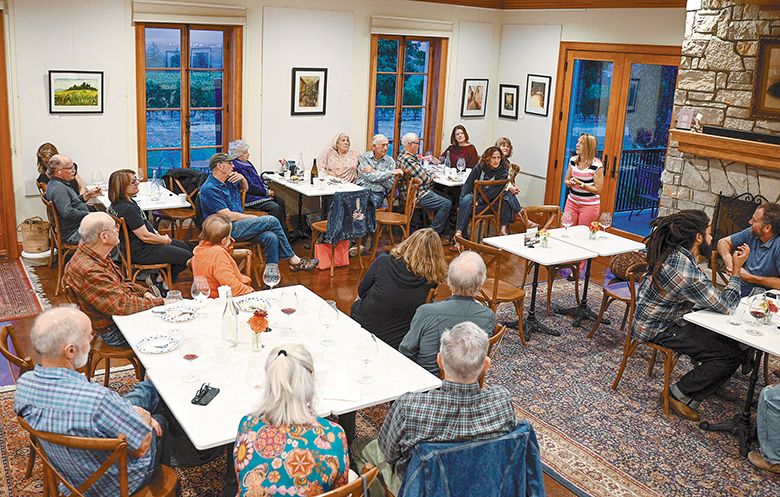
Despite the increasing sophistication of Oregon wine, WVWGG remains informal. “We pass an envelope around, and everybody contributes a dollar typically for the speaker,” Björnson shares. For certain gatherings, particularly when food is involved, attendees might pay as much as $10. There are no substantial membership dues. “You just have to show up,” he declares.
The venues have been unfussy too. Beck recalls the group meeting at Eola Springs Inn and later at a restaurant in Keizer before more recent gatherings at Chemeketa. Now members are considering another change: rotating meetings among wineries and finding locations more convenient to growers across the Valley. “If we can make it a little bit easier for folks around McMinnville to meet, we might be able to attract more people that otherwise may not come,” he admits.
The decades-old group continues tinkering with the same basic question, “how do you get growers into the same room?”
A CHANGING MOMENT
WVWGG no longer has the field to itself. “There are now Chardonnay and Pinot groups, and various other ways for folks to get to know each other,” Beck observes.
Chemeketa’s program has expanded. Linfield University has developed its own wine education program. Growers have far more opportunities to find information and one another than their predecessors did in the 1970s.
“The role played by the Willamette Valley WineGrowers Group has been diluted a little bit by these other avenues,” Beck acknowledges.
At the same time, recent discussions during WVWGG meetings have hardly become less urgent. Questions persist around smoke taint, microbiomes, legislative issues and using RNA interference to protect grapevines from pests, fungi and viruses. Björnson says growers are now confronting a difficult wine market while making decisions about what grapes they can actually sell.
“The wine industry is going through a little bit of a rough patch,” Björnson explains. While he believes the Willamette Valley is doing better than many wine regions elsewhere in the country, “it’s still not easy.”
Beck argues that despite the proliferation of other organizations and educational programs, growers continue to benefit from conversations, particularly as they work through the current market and broader changes in Oregon wine. “For many of us, like Mark and me, it’s a chance to learn what’s new,” Beck admits. “We still need to talk to each other– very frankly.”
To be added to the WVWGG mailing list, send an email to: laura.lockwoodmccall@gmail.com.
Aakanksha Agarwal is a wine, travel and lifestyle writer from India. Formerly a Bollywood stylist, she now resides in the U.S., embracing writing full-time while juggling family life and indulging in her passions for cuisine, literature and wanderlust.