
By the River’s Edge
Columbia Hills earns AVA status along a narrow stretch of Columbia River wine country
By Greg Norton
Wine lovers pouring a glass of wine from south-central Washington will soon see a new name on the bottle label. Federal regulators have recognized a narrow, ribbon-like stretch of land along the Columbia River by approving Columbia Hills as an official American Viticultural Area, or AVA.
The Alcohol and Tobacco Tax and Trade Bureau finalized the designation in August, making it Washington’s 22nd wine appellation. The new region sits between two existing AVAs: Columbia Gorge to the west and The Burn of Columbia Valley to the east.
ETCHED INTO THE LANDSCAPE
The Federal Register states AVA designations allow vintners to “describe more accurately the origin of their wines to consumers” and help buyers identify wines they want to purchase. Kevin Pogue, PhD, a geology professor at Whitman College and author of the Columbia Hills petition, acknowledges “producers can now say my wines are the way they are because they come from this place, and this place has these unique characteristics.”
The story of Columbia Hills traces back to the Missoula Floods, the cataclysmic Ice Age deluges that repeatedly scoured the Pacific Northwest and impacted soil profiles across the region. Columbia Hills’ northern boundary is tied to that history: the floods’ high-water mark is at 1,050-foot elevation. Below that line, the floodwaters stripped away topsoil. A thin cover of windblown silt and sand called loess settled atop the exposed basalt over the ensuing millennia.
These shallow, coarse soils force vine roots to push deep into the underlying basalt bedrock. The loose texture also drains quickly; a characteristic winegrowers favor for restricting vine vigor and concentrating fruit.
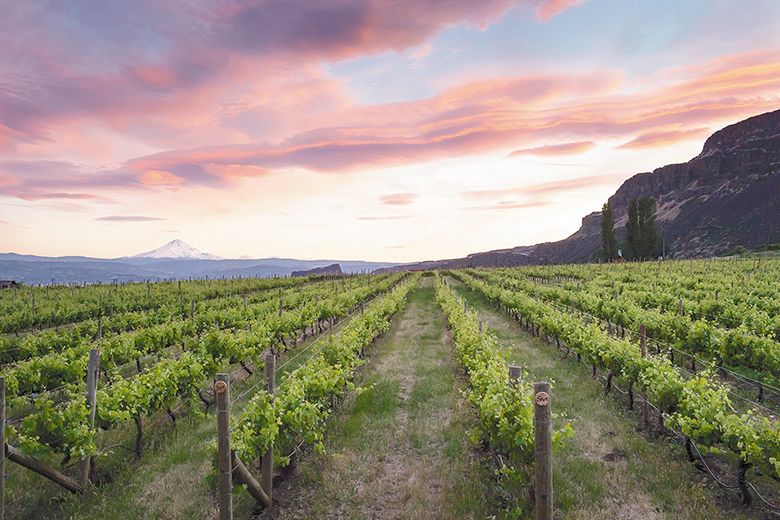
The ancient floods etched the slopes into stepped, south-facing terraces; the sunny terrain is now prized for vineyard sites.
BY THE RIVER’S EDGE
The new Columbia Hills appellation shares its name with a 35-mile ridge running above the river, as well as a nearby natural area preserve and a historical state park. The Columbia River warms the early mornings and extends the window growers have to ripen fruit. Elevations range from 74 feet to the 1,050-foot flood boundary, making the growing area distinct from its higher-elevation neighbors.
PUT A LABEL ON IT
Vines presently cover only 300 acres and four wineries call it home: Maryhill Winery, Cascade Cliffs Vineyard and Winery, Jacob Williams Winery and Waving Tree Winery and Vineyards. At fewer than 30,000 total acres, Columbia Hills is on the small side. But small is beautiful, according to Pogue, who has authored 11 AVA petitions. “I’ve tried to lean toward an ideal, where the physical characteristics within the boundaries are uniform and have the potential, at least, to affect the sensory components of the resulting wine,” he explains, contrasting it with large appellations that encompass widely differing conditions. “To me, it’s really cool knowing about the geography of where my wine’s coming from and why it might be the way it is.”
Wineries using fruit from within the boundary may now apply for labels citing “Columbia Hills AVA” as the appellation of origin. Both consumers and producers have a new tool to recognize these unique wines from those grown elsewhere.
The AVA designation gives the region a name and legal identity, but its character on the palate is still taking shape, vintage by vintage. For wine lovers, that makes Columbia Hills worth watching. It’s an appellation still early in its story, where this year’s harvest could help define what “Columbia Hills” comes to mean in the glass.
Greg Norton is a freelance writer with a broad background in nonprofit communications and the arts. He studied journalistic writing through the UCLA Extension and has traveled to wine regions around the world. Greg is a Certified Specialist of Wine and received the Level II award from the Wine and Spirits Education Trust. When not writing about wine, he can be found pouring it in a tasting room or wine bar near West Linn, where he lives. Read more by Greg atonthevine.blog.