These Roots Run Deep
The Deep Roots Coalition is preserving Oregon's dry farming legacy
By Gaston Guibert
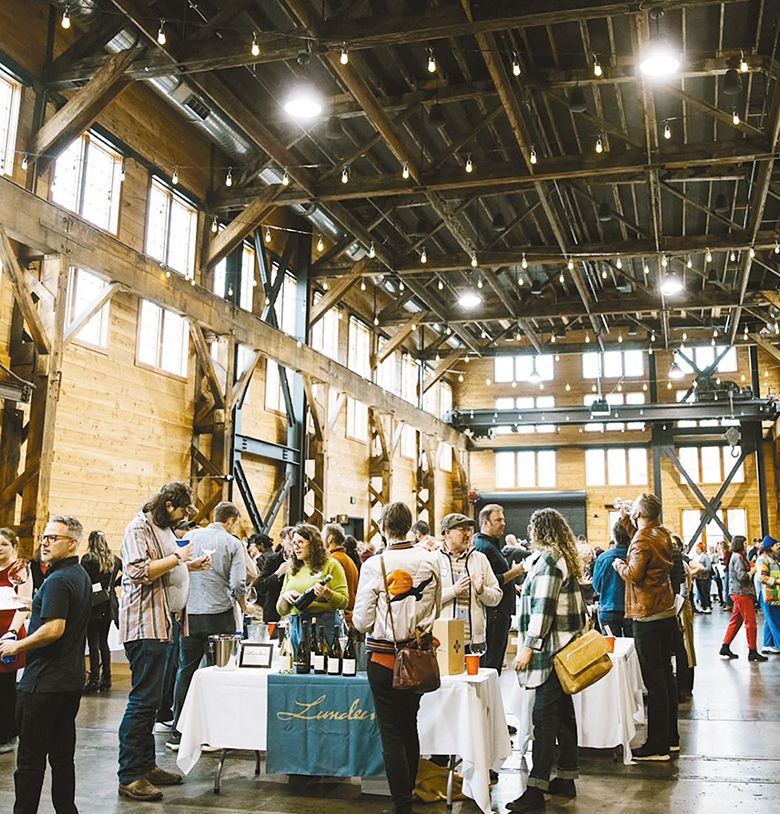
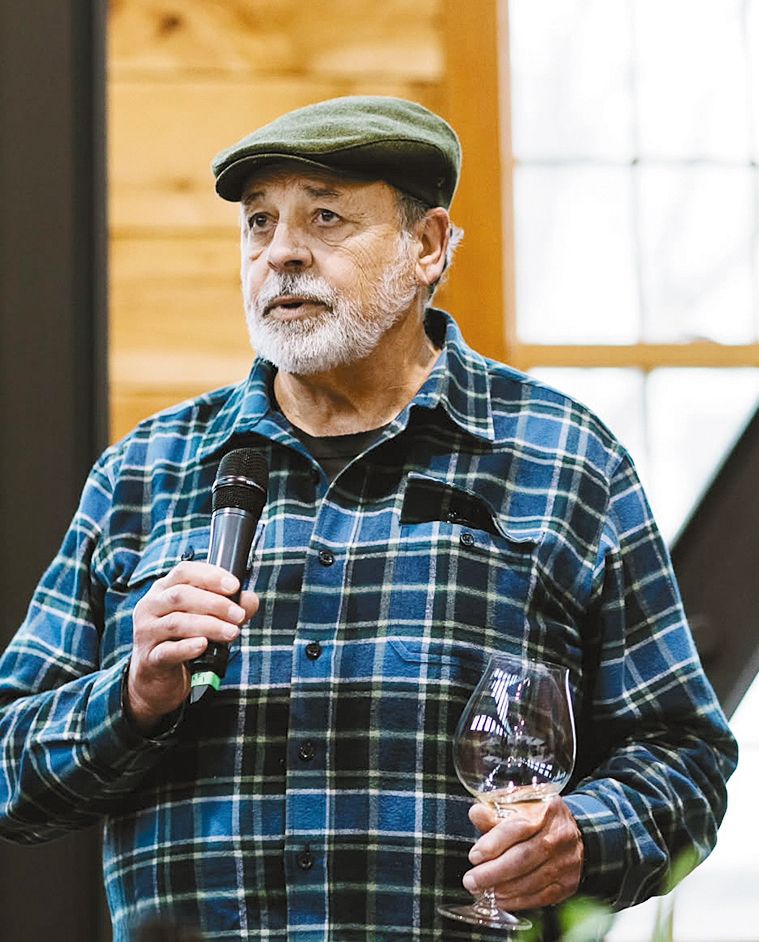
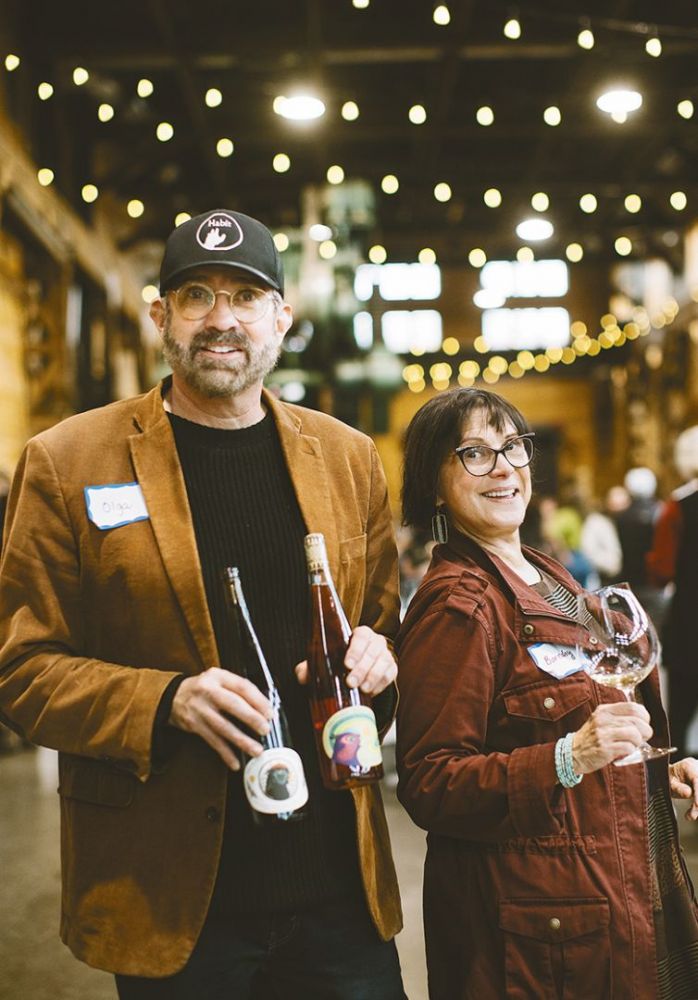
Walking into the annual Deep Roots Coalition trade tasting, I feel a palpable buzz of excitement. The opportunity to taste and celebrate many of Oregon’s best wines in one location draws an enthusiastic crowd of local buyers, sellers, winemakers and industry people. In early November, that energy crackles from the start, as founding winemakers John Paul of Cameron Winery and Doug Tunnell of Brickhouse Vineyards welcome guests. As an original member of the dry farming advocacy group during its informal beginnings, Tunnell, poised in a unique vantage point, comments on its origins.
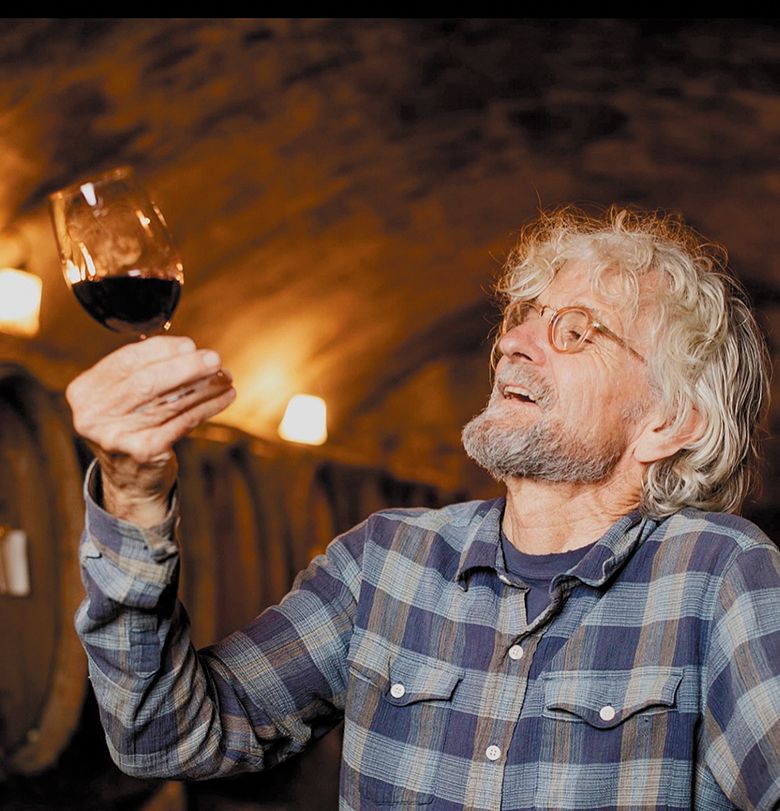
“I was around at the very beginning. The ‘roots’ of Deep Roots, back in the day,” Tunnell tells the crowd. “Flashing back to the 1990s. It really started with a series of Wednesday lunches in Dundee. John Paul was the host– the instigator, if you will– and there was a little cadre of people who got together to discuss growing grapes, and the best way to do it.” Noting the contributions of early lunch-eaters such as Russ Rainey, Bill Wayne and Don Oman, and later additions like Jim Prosser and current organization president Tyson Crowley, Tunnell reflects on their uniting beliefs.
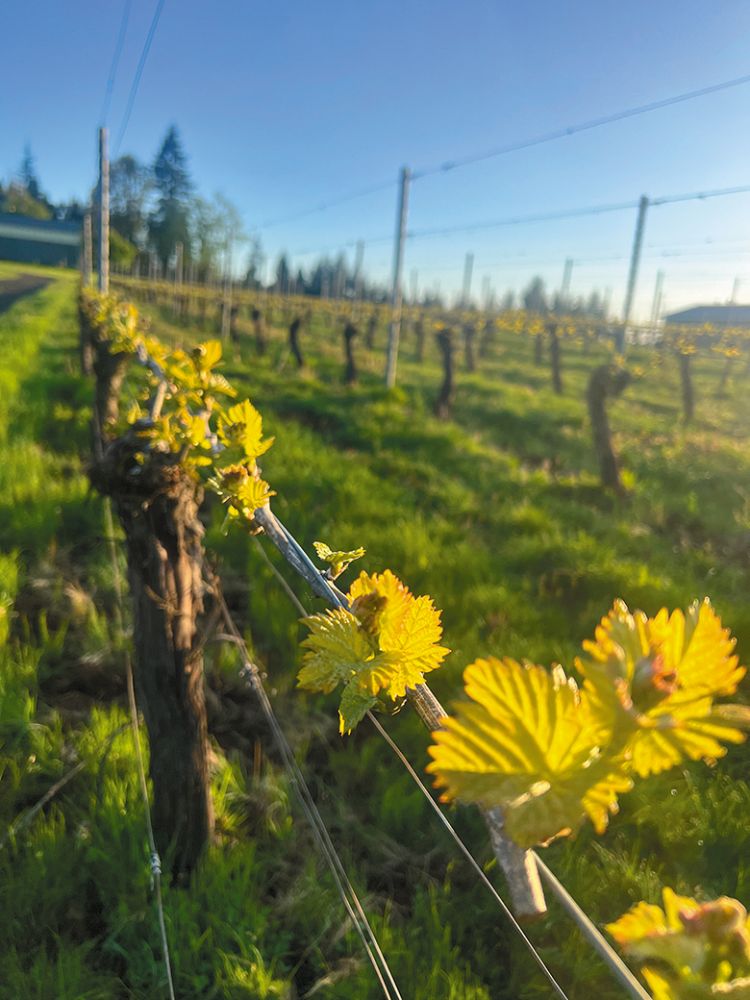
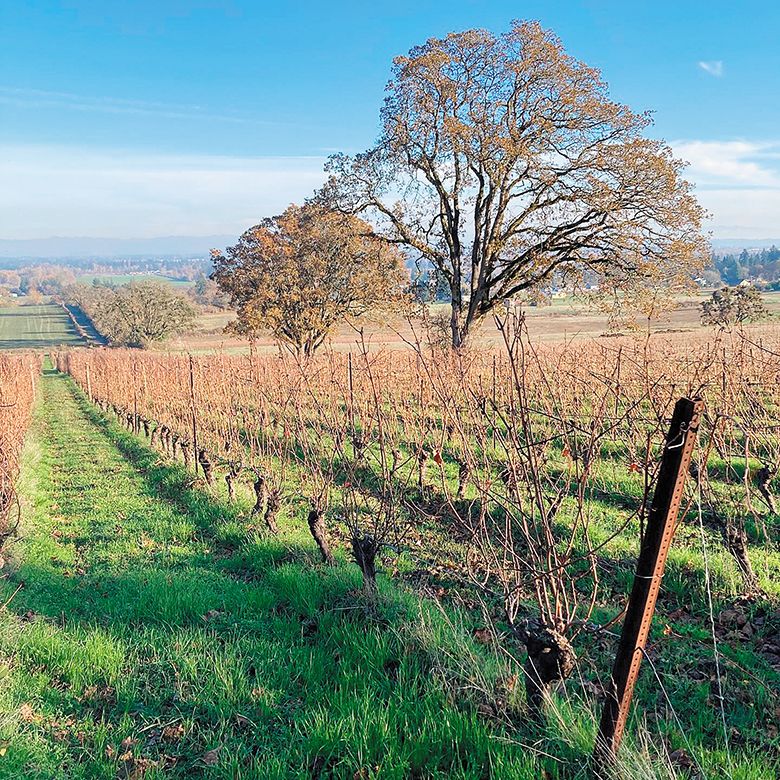
“With time, this little group really bonded over a couple of principles. One was just basic common-sense farming,” notes Tunnell. The first was the need to practice dry farming– or growing without irrigation. In a region with over 35 inches of average annual precipitation, growers shouldn’t need to irrigate their grapevines, they proposed, noting how European laws endorsed this belief. Dry farming advocacy would become the group’s calling card as they became more organized under the leadership of Rainey and Paul in the 2000s.
Along the way, Kyle Cheney, then Cameron Winery’s assistant winemaker, cheekily suggested naming themselves the “Deep Roots Coalition” – a humble Oregonian club with the same acronym as Burgundy’s famed Domaine de la Romanée Conti. The group decided the “drc” acronym should be lowercase to avoid confusion and potential lawsuits. It stuck, and the organization has steadily grown to its current size of 42 wineries.
Climate Change and The Irrigation Debate in Europe
From its inception, the Deep Roots Coalition has promoted water conservation and organic vineyard practices to enhance both wine quality and environmental stewardship. Traditional in nearly all European wine regions, dry farming encourages a deeper root structure, making the plant more resilient in drought situations, as well as in the face of rising average temperatures and intense heat spikes.
In the decades since the drc was formed, climate change has intensified. Today, many French Appellation d'Origine Contrôlée, or AOC, laws increasingly allow irrigation. While well-established dry-farmed vines may withstand heat waves and drought better than irrigated plants, delivering targeted amounts of water is now widely accepted as an effective tool. In response to a series of warm, dry events in the mid-2000s, the French government gradually began loosening irrigation restrictions, first in 2006, and more liberally in 2017.
Now, when drought or excessive heat strikes, growers are allowed to irrigate between May 1 and harvest. It's happened frequently: for example, over three consecutive vintages starting in 2020, winegrowers in Pessac-Léognan were permitted to irrigate.
Last August, Bordeaux’s irrigation situation made international news when Château Lafleur, one of Pomerol’s most prestigious producers, dropped its AOC status, citing “a strong decision that will allow us to face the reality of climate change with precision and efficiency.” The surprising announcement also recommended four drought-fighting viticultural interventions the AOC commission should consider, along with an extended defense of targeted irrigation.
This news launched a lively and ongoing debate about the potential need for traditional European regions to update their laws in response to the pressures of climate change. However, back in the Willamette Valley, drc members are preserving dry farming traditions by using improved technology and adopting a multi-faceted approach to vineyard management.
Evolving Approaches to Dry Farming
While the famously gravelly soils of some Bordeaux appellations may dry out quickly in drought conditions, Paul remains a skeptic. “They’ve been growing grapes for over a thousand years in Bordeaux, and I imagine there have been some hot and dry vintages along the way,” Paul argues. “What they want is more production. The bottom line is about money. That’s what drives irrigation.”
Regardless of French politics, many drc producers agree dry farming is a choice driven simply by quality. Gabriel Jagle, winemaker for Scenic Valley Farms in Gervais, notes, “We would get bigger yields if we irrigated our vines, but feel we would also be decreasing our quality. I’d rather have less ‘good’ wine than more ‘bad’ wine.”
This pursuit of quality over quantity is shared unanimously within the drc membership, and drives a wide range of viticultural strategies. Beneath the vines, fresh approaches to soil management have helped support dry farming. Increasing a soil’s organic matter content– once considered a problem that could lead to excess grapevine vigor– is now often an explicit goal toward improving the soil’s water retention capacity.
“We compost all of our pressings from the winery and our vineyard prunings as well,” Paul explains. “Composting is an art. It gets your fixed carbon in the soil up, and the more you can raise that, the more water retention your vineyard has.”
What’s beneath the vines is only part of the water story, however: canopy management is another powerful tool in water conservation. Since plants lose water through transpiration as they cool themselves, reducing a vine’s canopy is one of the most effective ways to minimize soil water depletion. Today, many producers, including Cameron, limit canopy size by hedging their vineyards during the growing season. Traditionally done to reduce powdery mildew pressure, it has the added benefit of conserving water during heatwaves.
Even during the dormant days of winter, thoughtful approaches to farming can support the goal of dry farming. At Sequitur in Ribbon Ridge, assistant winemaker Colin Kapps helps oversee the annual pruning work. Leaning on the Simonit and Sirch method of reducing the number and severity of pruning cuts, each grapevine has a more natural flow of water and nutrients from the plant’s roots out to its extremities.
“With fewer desiccation cones (areas of dead wood) and cross cuts, the flow of water is more linear and efficient,” Kapps explains. “Theoretically, there should be less wasted energy to feed the vine with the finite reserves of water.”
From thoughtful pruning to careful canopy management and evolving soil management strategies, Oregon continues as a world leader in developing diverse farming methods for preserving water resources in the face of climate change.
Trade Tasting, continued
Back at the tasting, I work my way around the dozens of tables, nervously approaching each winemaker with my request: Would you mind filling some of my little glass bottles, so that I can taste fifty of them blind in my basement tonight and write about it for the Oregon Wine Press? Some form of “Sure!” is invariably the response. Shuffling through my backpack to set up a few bottles, caps and a funnel on crowded tasting tables, nobody seems bothered by my unusual tasting approach. In fact, I can’t imagine a more laid-back group of winemakers anywhere.
There is a perceptible air of mutual reverence in the room, and everyone seems proud to have their wines tasted alongside those produced by fellow drc members. With regard to the collegial feel, many speak of Rainey, co-founder of the drc and founder of Salem’s Evesham Wood Winery, who died in 2022.
“I one hundred percent believe the reason it’s such a great group of human beings is that Russ was such an awesome person, and people just wanted to be involved with the stuff that he was doing,” Jagle affirms. “This drc is still very much in his image.”
At the end of the afternoon, after engaging in dozens of lively conversations, yet sampling almost no wine, I leave with a backpack of liquid gold: 50 two-ounce bottles of juice from a variety of producers, all made from dry-farmed vines, thoughtfully transformed into wine by some of the state’s most celebrated winemakers. More importantly, the event serves as a resounding reminder… the best of Oregon’s wine industry members share some remarkable qualities. Our producers farm their grapes with regard for nature. We have smart, curious winemakers who collaborate on how to best make authentic, terroir-driven wines and a lot of good people who admire and celebrate each other’s work.
Tunnell captures this sentiment with his closing statement: “We share a respect for the beauty of the grapevine, its incredible strength and ability to adapt, and give us beautiful wine and beautiful grapes. All of us share respect for each other, and for each other’s wines. Cheers to the drc, and cheers to the notion of keeping true to our roots.”
Blind Tasting Results
The experience of blind tasting 50 superlative wines is eye-opening. Despite tasting for four hours (after ten hours of socializing, sample collecting and bottle prepping), the overall quality and energy of these wines is impossible to miss. Here are my top ten:
The Classics: Pinot Noir and Chardonnay
Evesham Wood Winery 2021 Le Puits Sec Pinot Noir, Eola-Amity Hills
Savory, deep and brooding nose of black compost, licorice and damp earth. Beautifully cohesive flavors across the spectrum of black: blackberry, black cherry, smoke, allspice and star anise. Ample, chewy tannins, with supremely fine texture. A “stop-you-in-your-tracks” exceptional wine.
Evesham Wood 2023 Temperance Hill Pinot Noir, Eola-Amity Hills
Bright red fruits– perfectly ripe strawberry and cherry– smack the palate right away, transitioning to brown, dusty earth and cinnamon; charred wood and subtle cola spice on the finish. Lovely texture, fine and elegant without being over-polished. A vibrant and thoroughly delicious wine, but not lacking in seriousness or character.
Crowley Wines 2023 La Colina Pinot Noir, Willamette Valley
Pleasantly perfumed aromas of violets, cinnamon and bright cherries with subtle umami playing in the background. Soft, supple tannic structure stands out on the palate. Charming and elegant, a delight to taste!
Illahe Vineyards 2021 Percheron Pinot Noir, Willamette Valley
A classic nose of bright red fruits, cinnamon and earthy spice. A core of perfectly ripe red cherry and strawberry fruit dances with energy on the palate. Subtle herbal accents of fennel seed transition seamlessly into a long, savory finish. A shining example of balance.
Illahe 2022 “1899” Estate Pinot Noir, Willamette Valley
Brightly spiced aromas of star anise and cinnamon stick flow from the glass. The spice parade continues on the palate– allspice, nutmeg, sarsaparilla, with no heavy oak influence to cloud the picture. The pure fruit complexity shines here– black cherry and earthy underbrush. A soulful, delicately crafted example of classic Oregon Pinot Noir.
Walter Scott Wines 2023 Cuvée Anne Chardonnay, Eola-Amity Hills
A wonderful nose of citrus fruits, petrichor and subtle, lightly toasted vanilla. Palate offers gunflint and smoke, nicely balanced by generous fruit flavors of apricot, peach, tangerine and Meyer lemon. A lively mineral texture and fresh lemon curd quality make this totally complete.
Walter Scott Wines 2023 Freedom Hill Chardonnay, Mount Pisgah of Polk County
Vibrant nose of smoldering gravel with citrus zest undertones. Lively flavors of lime juice and zest are electric on entry, but give way to a silky, enveloping lactic texture. Lightly charred wood and toasted bread flavors add intrigue, while bright acidity and prickly minerality give it structure. Exceptionally complex now, and certain to improve with time.
Twill Cellars 2023 Bracken Vineyard Chardonnay, Eola-Amity Hills
Beautiful mingling of fresh baking spices, vanilla and energetic lime zest on the nose. Flavors notably pop on the palate– fresh lime juice perfectly softened by clove and fresh vanilla, with a savory touch of toasted bread. Outstanding wine, excellently crafted.
Other Varieties:
Beckham Estate Vineyard 2023 Gamay Noir, Chehalem Mountains
Pleasantly fragrant nose of fresh, juicy raspberries. Lovely balance of fruit, spice and savory flavors. Bright red raspberry, cinnamon, dusty brown earth and button mushrooms deliver a surprisingly complex array of flavors. A light and elegant body combined with refreshing acidity makes this a delight to drink.
Decision Hill Wines 2023 “Greens and Purples” Wirz Vineyard Riesling, Cienega Valley, Monterey
Classic Riesling aromas of citrus and stone fruit come pouring out of the glass. Shows an impressive range of fruit flavors, from ripe Meyer lemon to juicy apricot and dried peach. Dry, but with a certain richness and ripeness that give it a rounded body. Reminiscent of fine Austrian Rieslings. Classic, pure and very good.
Gaston Guibert is a wine writer and WSET educator based in Portland. His ten-year career in the wine industry has been evenly split between distribution and retail sales. Along the way, he passed the Master of Wine Exam in 2024, completed the WSET Diploma program in 2021 and worked harvest internships in 2022 and 2025. At home, nothing makes him happier than enjoying a home cooked meal of garden produce with his fiancée and their quirky, sweet dog. Contact him at gastonguibertwine@gmail.com.