
Tender Mercies
As bud break changes, frost risk intensifies
By Aakanksha Agarwal
Most spring mornings in Southern Oregon, Abacela’s vineyards look composed. The rows sweep across slopes. Designed specifically for airflow, the vineyard has very few flat areas where cold air can settle.
Yet, Greg Jones checks the forecast.
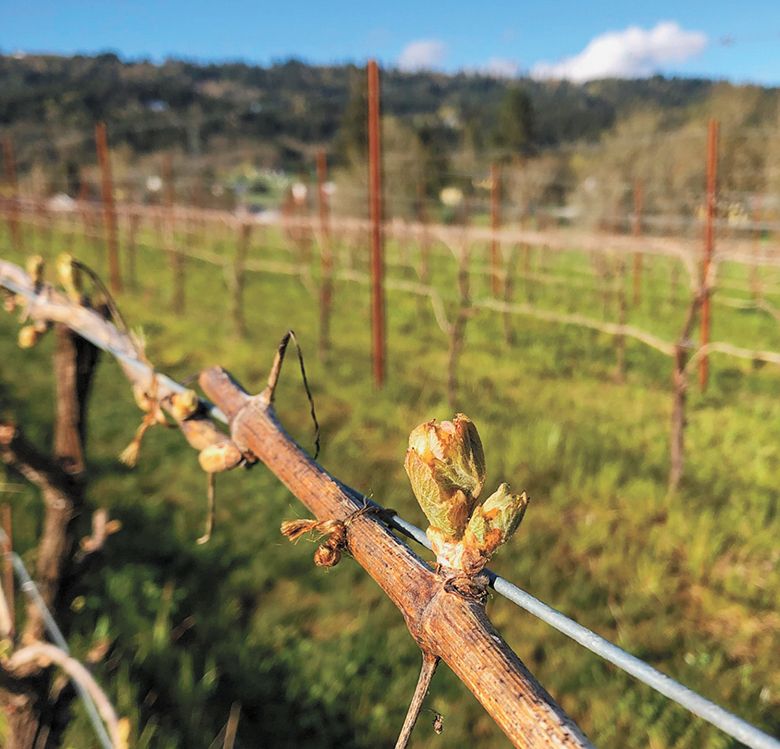
Jones, CEO of Abacela, is also a climatologist who has studied wine and climate relationships since the early 1990s. He has tracked bud break, the stage when fuzzy buds emerge from the previously dormant vines, at his family’s property for more than three decades. Across 16 planted varieties, the long-term average is April 9, typically varying about a week on either side, depending on the season.
What concerns him isn’t the date. But rather the alignment with the coldest air of the spring.
“Bud break is the least predictable of all phenological events,” states Jones. “It’s primarily dependent on the relationship between the temperature in the atmosphere and that of the soil.”
Unlike flowering or veraison (when grapes change color and begin to soften), bud break responds to a complex interaction between soil warmth and air temperature. Cool, wet soils can delay growth even when spring days feel mild. Dry soils paired with warm air can accelerate development.
Across much of the wine world, bud break has advanced over the past two decades. In some regions, like Oregon, it now begins 10 to 14 days earlier. In other winegrowing areas, it has advanced by five to seven days.
But the frost window has not moved in perfect sync.
“It’s not just about how cold it gets,” Jones notes. “It’s about what stage the vine is in when the cold arrives.”
That stage matters because each grape bud contains three potential growth units. The primary bud produces the most fruitful shoots. Secondary buds serve as backup, often capable of delivering roughly 70 percent of a normal crop (depending on variety and year). Tertiary buds contribute even less.
“If bud break occurs without damage, you get primary shoots that are the most fruitful of all,” Jones explains. “If you sustain damage, it doesn’t mean you lose the crop. But you’re relying on the backups, which are less fruitful.”
April 14–15, 2022
In Oregon, growers still remember the start of the 2022 growing season in intense detail.
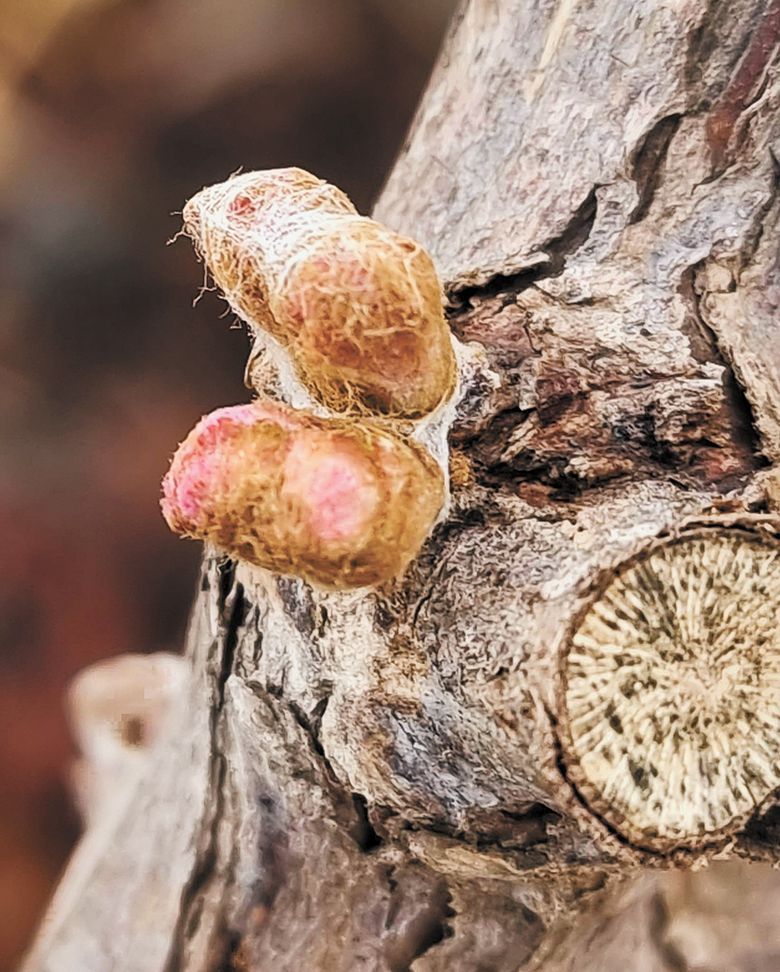
“In 2022, we were a bit early phenologically, but not super early,” recalls Evan Bellingar of Century Vineyards, a vineyard management company serving the Northern Willamette Valley. Pinot Noir was largely at late woolly bud, where the buds were still brown and hadn’t yet fully emerged yet. Chardonnay had pushed further, with shoots already half an inch out.
When the freeze hit, the primary bud damage was horrendous, but it took a while to find out,” Bellingar admits.
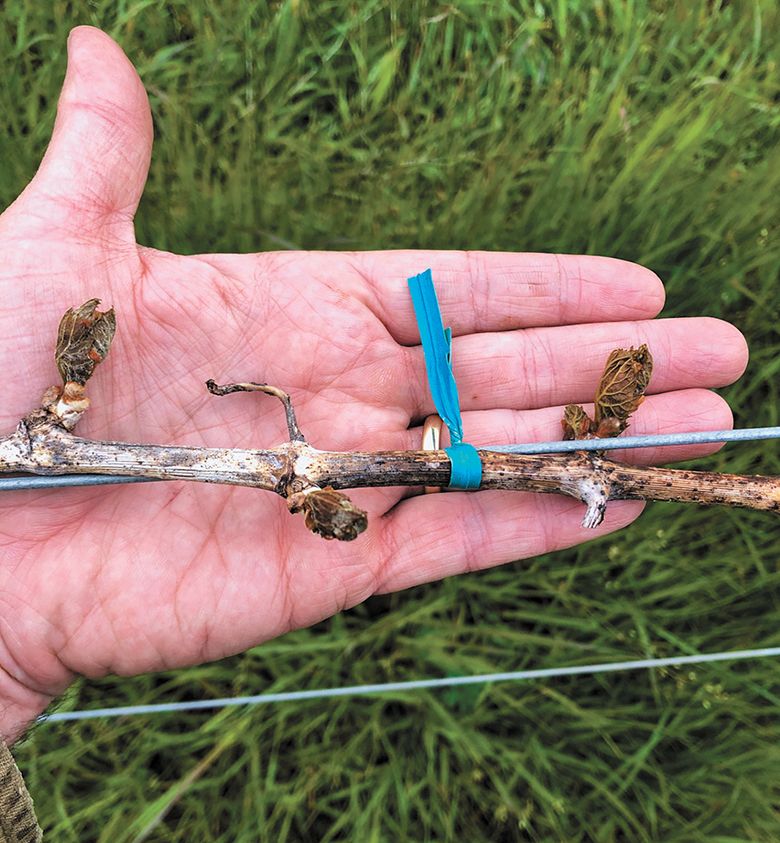
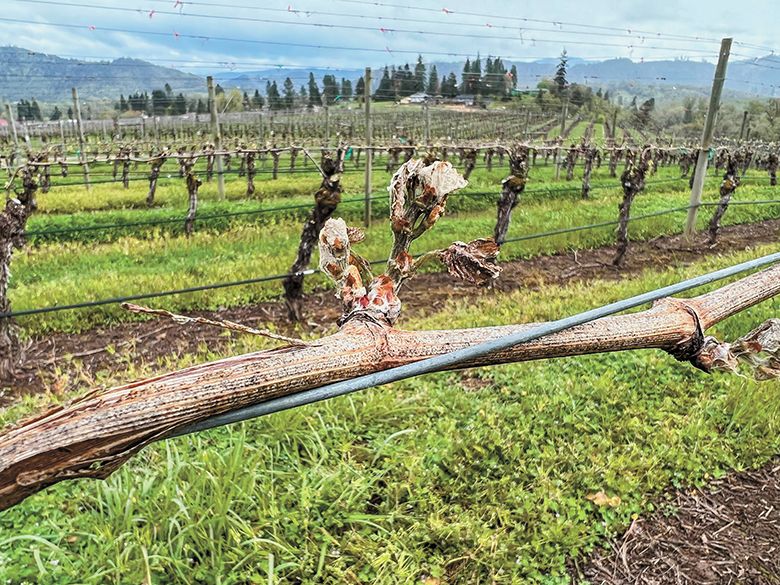
In Chardonnay, the signs were unmistakable within hours. Buds, once vigorous, darkened and collapsed.
“Like salad that accidentally got frozen and then thawed. Or rotten spinach. We knew those buds were smoked.”
Pinot Noir, at woolly bud, told a subtler story. Bellingar recalled visiting a site days later that he believed hadn’t sustained damage.
“I remember exactly where I was as I walked through a vineyard where I didn’t expect to find much damage. All the woolly buds I hoped had been spared were instead soft, moving back and forth freely like broken toggle switches.” He confesses, “I felt physically ill.”
In most frost events, cold air pools in low areas and drains downhill like invisible water. Growers know where those frost pockets lie. That spring was different.
“The entire atmosphere was below freezing,” remembers Bellingar. “There was just no escape.”
Higher elevation sites fared better largely because the grapevines weren’t as far along.
On Ribbon Ridge, Daniel Warnshuis of Utopia Vineyard experienced significant loss. Warnshuis purchased what had been a horse pasture in 2000 and developed Utopia across 18 acres, most planted with a dozen distinct Pinot Noir clones and three low-yielding Chardonnay selections. The vineyard, between 450 and 480 feet in elevation, is on a south-facing, gently sloped hillside of Willakenzie soils.
It’s typically insulated from late frost.
“The only exception in 25 years was 2022,” reports Warnshuis. Bud break had just occurred, so the late freeze destroyed nearly 100 percent of the primary buds. The growing season ultimately produced about a 50 percent decrease in average yield, the lowest in Utopia’s history.
“We knew we had damage,” Jones shares. “We thought Abacela’s yields were going to be down 30, 40 percent.”
Then secondary buds pushed. Across much of Oregon, the season reset roughly four weeks behind schedule. Flowering occurred under favorable July weather. By harvest, vineyards that had braced for severe losses found themselves with viable crops.
“We ended up having a very good year yield-wise,” Jones acknowledges.
Bellingar still sounds incredulous.
“Those shoots pushed about four weeks later, so now we were a late-starting vintage,” he asserts. “The vines flowered during great weather in July. We ended up with a huge crop potential.”
The lateness created new anxiety. Full ripeness would require extraordinary heat.
“It would have taken an unprecedentedly hot October.”
They got one. “That year,” Bellingar says, “was the miracle vintage.”
What can be managed
Recovery does not erase risk.
For Jones, adaptation begins long before April. “Site selection is number one,” he notes.
At a macro level, regional climate sets baseline exposure. Eastern Washington’s continental cold differs from Southern Oregon’s moderated profile. At a micro level, slope and air drainage determine whether cold air drains away or settles.
“You want cold air to move past your vineyard,” declares Jones. “You don’t want cold air pooling in and around your vineyard blocks.”
Warnshuis built Utopia through similar logic. But 2022 demonstrated that when the entire atmospheric column drops below freezing, geography cannot guarantee protection.
In years when late frost threatens, Warnshuis now monitors advisories closely. Vineyard floor management becomes part of the response. Mowing grass between rows and beneath the canopy can modestly affect heat exchange. Reducing moisture-trapping vegetation may improve soil heat gain during clear nights. Creating a lightly mulched or bare strip beneath vines can enhance heat transfer.
The impact is incremental. “It depends on how cold it actually gets,” observes Warnshuis. “If temperatures dip just below freezing, it can make all the difference. If they drop into the low 20s, additional measures must be taken.”
Those actions may include chemical frost protectants, sprinkler irrigation or smudge pots, depending on infrastructure.
Pruning architecture offers additional protection. In two-cane systems, common in the Willamette Valley, delayed pruning can slow bud break. In spur-pruned systems, however, leaving longer spurs intact prioritizes vertical growth, preserving apical dominance. Upper buds break first and hormonally suppress lower buds. If final cuts occur after the frost window, basal buds remain dormant, effectively delaying development.
“It is a great strategy in spur-pruned vines,” Bellingar states. “Potentially gaining two to four weeks before bud break begins.”
Spur pruning, once rare in parts of Oregon, is gaining traction for this flexibility and because it aligns with mechanical pre-pruning.
Even so, growers acknowledge the limits. Jones does not describe 2022 as common or inevitable. At Abacela, it remains the only spring frost in over 30 years.
“When you have winters that are extremely dry and not very cold, and strong Arctic influences still possible in the spring, the potential for cold weather is out there,” he warns.
Warnshuis places bud break alongside bloom as the two most consequential stages of the season. Since 2022, frost window identification in March and April is more active, technical and urgent.
Across sites, bud break is no longer simply the hopeful start of a vintage. It is a defined risk window.
Winegrowers track soil temperature, air movement, slope position and short-term weather models. In a typical radiation frost, topography may be enough. In a full atmospheric freeze, even an ideally located site can lose primary buds. Even in modern times, Mother Nature still determines the outcome.
Aakanksha Agarwal is a wine, travel and lifestyle writer from India. Formerly a Bollywood stylist, she now resides in the U.S., embracing writing full-time while juggling family life and indulging in her passions for cuisine, literature and wanderlust.