Root Structure
At Lexème Wines, two winemakers craft a shared vision
By Aakanksha Agarwal
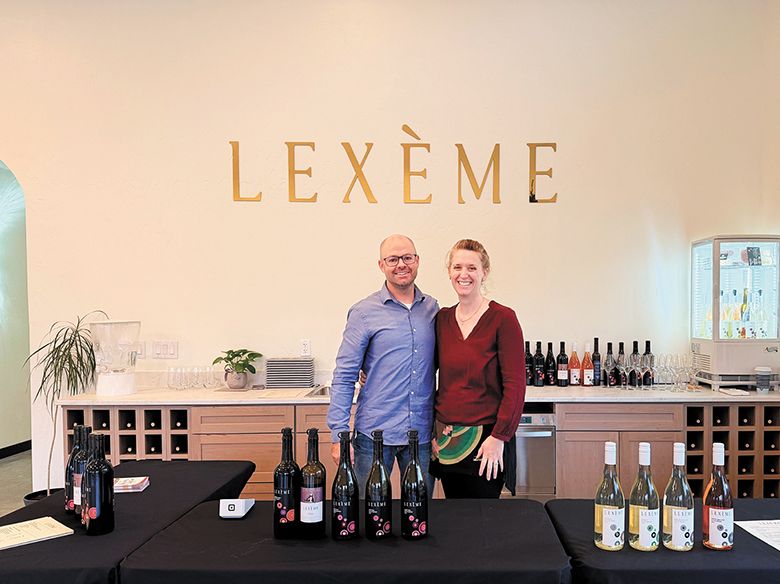
From the windows of Lexème Wines’ new tasting room in Oregon’s Elkton growing region, visitors can see rows of grapevines slope toward the Umpqua River. For Christopher Hudson and Monja Hudson-Desmeules, the proximity is intentional. Their wines, focused on site specificity, now make that obvious before the first sip.
Monja Hudson-Desmeules’ first lessons in wine occurred at the Sunday table in French-speaking Switzerland.
She remembers her father lining up bottles for blind tastings, “just for fun.” The weekly ritual was playful but practiced with rigor. As a child, she watched closely, learning the language and cadence of tasting. She also accompanied her parents on trips to Burgundy, where they sampled wines from barrels.
Hudson-Desmeules eventually earned a degree in enology and viticulture engineering in Switzerland. She imagined opening a wine bar. “Then I fell in love with viticulture and winemaking,” she recalls.
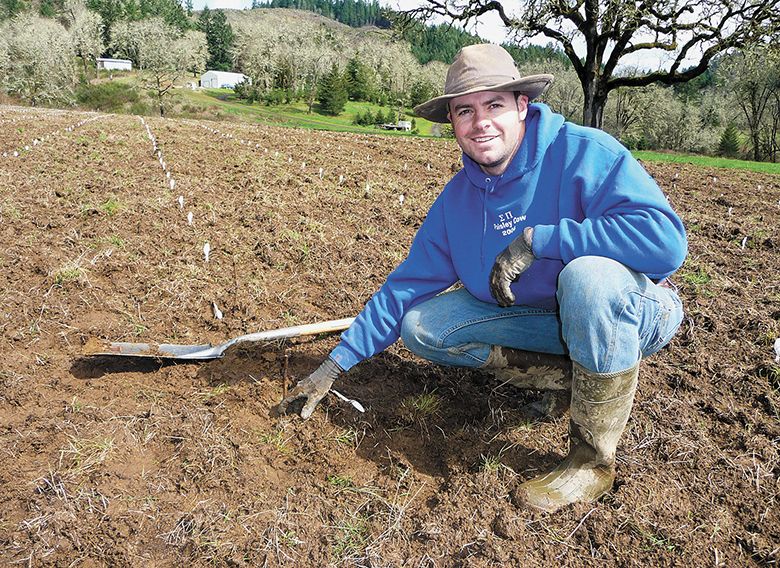
Across the Atlantic, Christopher Hudson’s relationship with wine began with land. A sixth-generation Oregonian from Central Oregon, he grew up fishing and hunting, rooted in a rural landscape where farming was practical and elemental. While studying chemical engineering, an opportunity to pivot into winemaking presented itself. “I found the pathway I’d been looking for,” Hudson admits. Following it kept him close to farming and satisfied his analytical instincts.
They met in 2006 during harvest internships at King Estate. Both had completed university degrees and were seeking practical cellar experience under an established winemaking team. They found themselves working side by side in the after-hours stretch of harvest season. “King Estate assigned us to the night shift,” shares Hudson-Desmeules. “We started hanging out quite a bit.” By the end of the internship, their professional partnership had evolved into a personal one.
Within a year, they had traveled to Switzerland, then to New Zealand for another internship. The couple married in 2007 and had their first child the following year. The pace was swift, but the direction was clear from the start. “When we started dating, I told Christopher my dream was to start my own thing,” Hudson-Desmeules confesses. “He shared the same dream.”
A Region Still Becoming
After returning to Oregon, they began searching for vineyard land, initially in the Willamette Valley. Hudson went back to King Estate, using his lunch breaks to tour vineyards and study potential sites.
But the Valley felt defined, perhaps even settled. Southern Oregon offered something else.
“Christopher often reminded me, you know, in the Willamette Valley, it rains all the time,” observes Hudson-Desmeules. Hudson, raised in a drier climate, favored Southern Oregon’s balance: warm enough for reliable ripening, dry enough for control, but not excessively hot. They shifted focus to the Elkton area of the Umpqua Valley, a cooler pocket influenced by the Umpqua River and coastal air.
The area had potential for Pinot Noir, but it also felt open-ended. There was space for interpretation. “It’s nice to come to an area where there’s something to be built,” Hudson-Desmeules declares. “There’s still work to do.”
In Elkton, Gamay thrives. Malbec and Viognier experiments show promise.
After a four-year search, they purchased property as 2010 came to a close. Hudson fell in love first. On the Umpqua River, it has south-facing slopes and sweeping views across the Valley. “To me it was too big,” Hudson-Desmeules admits now. But the river, hills and small town of Elkton sealed the decision.
Planting Identity
Launching their label in 2015, they chose the name Lexème, French for “root of a word.” The name carries layered meaning. It references “vine roots taking hold in Oregon soil. It gestures toward language, translation and cultural inheritance. It signals our shared commitment to understanding what lies beneath the surface,” Hudson-Desmeules acknowledges.
The winery mirrors the couple’s dual heritage, blending Swiss precision with Oregon independence and analytical training with instinctive farming. Their division of labor is fluid, but all tastings are a shared job. “We both taste the wines, making decisions together,” Hudson-Desmeules explains. “It’s always nice to consult with each other.” Hudson sees that dynamic as essential.
Minimal Intervention, Measured Hands
Lexème’s philosophy is straightforward but disciplined. “We like to really have great expressive wines,” Hudson-Desmeules reports. “We don’t like manipulating the wines at all.”
In practice, this means minimal cold soaking and warm, clean fermentations. Extraction is handled gently. “Light pressing to keep gentle extraction,” Hudson explains, “so it’s very manageable on what we’re getting to express into the barrel.”
The wines age exclusively in French oak, though new oak is used sparingly. The aim is expression of fruit and structure without cosmetic embellishment. They avoid heavy-handed fining agents, preferring to let the wines age naturally, with a refined lees stirring program.
The approach is not dogmatic so much as attentive. Each vintage is evaluated on its own terms. “If you think one vintage is easy,” Hudson states, “then I just don’t think that you’re really paying attention.”
Pinot Noir leads the portfolio, as it does for many producers in Elkton. The cooler climate allows for acidity and balance, and the couple’s training favors elegance over excess. But Gamay has emerged as a defining grape for the site.
The winery recently released its first estate-bottled Viognier, and Hudson-Desmeules says the response has been positive. “People have been absolutely loving it.”
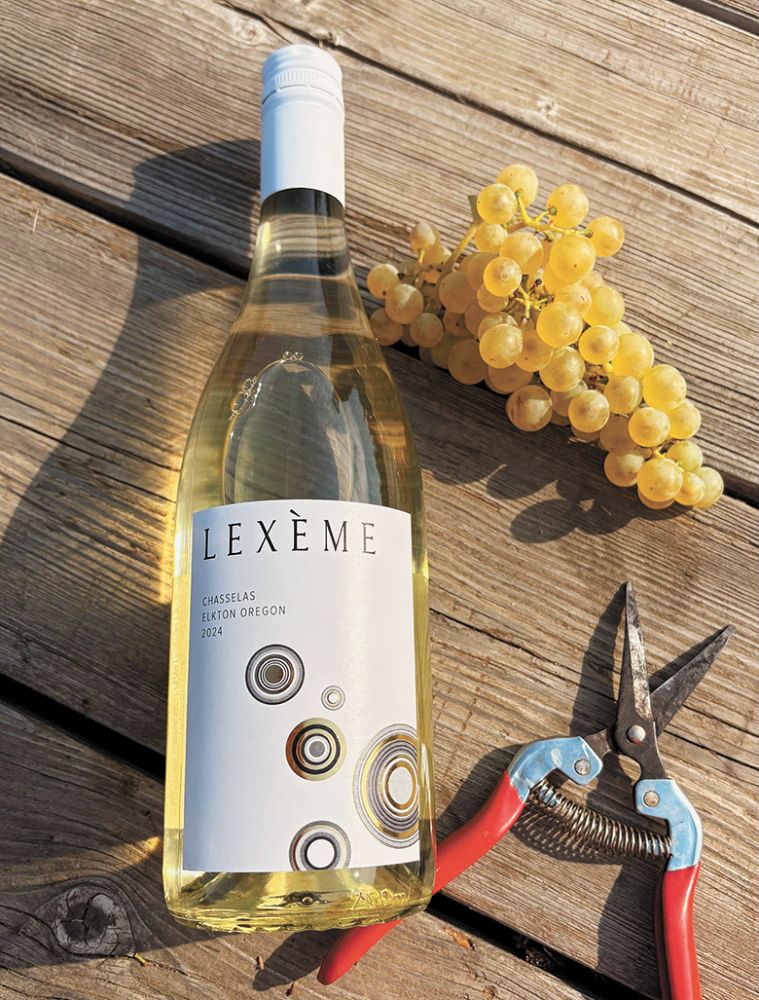
Then there is Chasselas, a Swiss variety uncommon in Oregon. The couple planted the grape in 2018, driven as much by nostalgia as by a desire to explore. In Switzerland, Chasselas is considered a terroir-translating grape. Regions hold competitions in which tasters identify origin by subtle shifts in minerality and texture.
“I was so excited to see how it would do in new volcanic soil,” Hudson-Desmeules recalls. Swiss Chasselas often grows in granitic soils. In Elkton, the volcanic influence gives rise to a distinct expression. She describes the wine as “very floral, with lots of linden blossom and some pear notes as well. The minerality is surprisingly comparable to a Chasselas from Switzerland.”
The variety has become one of the winery’s signatures.
Building Community
Lexème opened its first tasting room in Elkton in 2017. The small space in town allowed the brand to build a direct-to-consumer following. For six years, visitors regularly asked the same question: Where is the vineyard?
In 2023, they closed that tasting room, anticipating a move to a larger space at the vineyard itself. However, construction took longer than expected, and the couple grew their family by welcoming twins.
The new tasting room finally opened over the Thanksgiving holiday weekend. Large windows frame the vines. The Umpqua River is visible in the distance, and the vineyard is no longer an abstraction.
“The centerpiece of the tasting room is our vineyard,” states Hudson.
The expanded space allows for wine club gatherings and, beginning this spring, charcuterie plates will be available. It also represents the completion of a long-held vision: a place where roots, literal and linguistic, are visible.
For all the discussion of soil, fermentation and varietals, the couple returns repeatedly to one theme: people.
“The hardest thing was evolving this to be a business where we could have people in front of us to enjoy our wines,” Hudson explains. The gratification, he adds, comes from that very interaction.
Hudson-Desmeules agrees. She refers to customers by name and takes pleasure in seeing someone respond to a wine she shepherded from bud break to bottle. “Just watching them enjoying what we do,” she says, “is a huge pleasure to us.”
Lexème Wines
8854 Bullock Rd., Oakland (South of Elkton)
Wed. – Sat. 11 a.m. to 5 p.m.
lexemewines.com
(541) 802-6016
Aakanksha Agarwal is a wine, travel and lifestyle writer from India. Formerly a Bollywood stylist, she now resides in the U.S., embracing writing full-time while juggling family life and indulging in her passions for cuisine, literature and wanderlust.