
Pageantry and Purpose
How The Oregon Wine Brotherhood has championed the industry for 30 years

By Greg Norton
“Burn old wood, read old books, drink old wines, have old friends.” -Alfonso X (1252–1284), King of Castile, promoter of Sherry and reputed inventor of tapas.
Over many years, a dedicated group of friends has quietly united around Oregon wine. Traveling and learning together, they promote our region and keep a reverent eye on the storied history of the vine. For 30 years, this group, The Oregon Wine Brotherhood, has actively supported the industry’s growth and celebrated its place in wine culture.
FRENCH ROOTS
Since before the Middle Ages, guilds of people have engaged in the growing, making and serving of wine. The earliest wine brotherhoods emerged in 13th-century France, where they served the royal court as stewards of wine and keepers of its ritual. “Cup bearers” managed royal cellars and collected taxes on wine. The title of “Grand Cup-Bearer”– or Grand Échanson– became a high honor, complete with ceremonies and attire evoking knighthood. The modern custom of a host tasting wine before serving it to guests traces back to these early guardians, whose job once included ensuring the monarch’s wine wasn’t poisoned.
Although the French Revolution swept away these trappings, a longing for pageantry endured. The 20th century marked a renaissance of wine brotherhoods in France, with the first post-revolution group convening in the Loire Valley in 1904. The movement gained momentum in 1934 with the founding of the Confrérie des Chevaliers du Tastevin in Burgundy.
Numerous brotherhoods soon followed. Some aimed to restore the rituals of previous groups. Others sought to promote a region’s local wine, prompted by the adoption of the Appellations d’Origine Contrôlée system, or AOC, in 1947. Brotherhoods also sprang up in other countries, and by 1964, the Fédération Internationale des Confréries Bachiques, or FICB, based in Paris, united dozens of wine brotherhoods scattered worldwide under a single banner.
OREGON KNIGHTS
Oregon’s part in the story began in 1979 when John Bauers founded the state’s chapter of the Universal Order of the Knights of the Vine. The group’s mission echoed the inherited core values– respect for tradition, fellowship and regional pride– with an Oregon spirit. After receiving its charter from Norman Gates, grand commander of the Knights in Sacramento, the Oregon chapter quickly became one of the organization’s most active.
As the Oregon wine industry developed in the 1980s and early 1990s, so did the Brotherhood. In 1994, Paul DeBoni, then Oregon’s master commander, met with international wine leaders, including FICB’s Duane Young. They recognized Oregon’s growing wine reputation deserved its own independent brotherhood, one that would reflect both its regional character and directly connect it to the broader wine world.
With support from Bauers, Ron Hayes, and other founding members, DeBoni led the effort to withdraw from the Knights of the Vine and form a distinct organization, one approved by the FICB. New insignia, robes, emblems, colors and traditions all had to be created. After much discussion– and more than a few shared bottles– the group settled on a name that reflected its mission and identity: The Oregon Wine Brotherhood.
“This started up here as a circle of friends and grew into a larger circle of friends,” Hayes recalled in a 2017 oral history interview at Linfield University. “We felt the purpose was to get people together with like interests and like minds,” he continued. The circle ringed a wide swath of industry professionals and passionate consumers.
“It was very special because everyone was very enthusiastic about wines, especially Oregon wines,” affirmed Paul Hart in the same interview. “It was definitely a very busy time that involved a lot of people.”
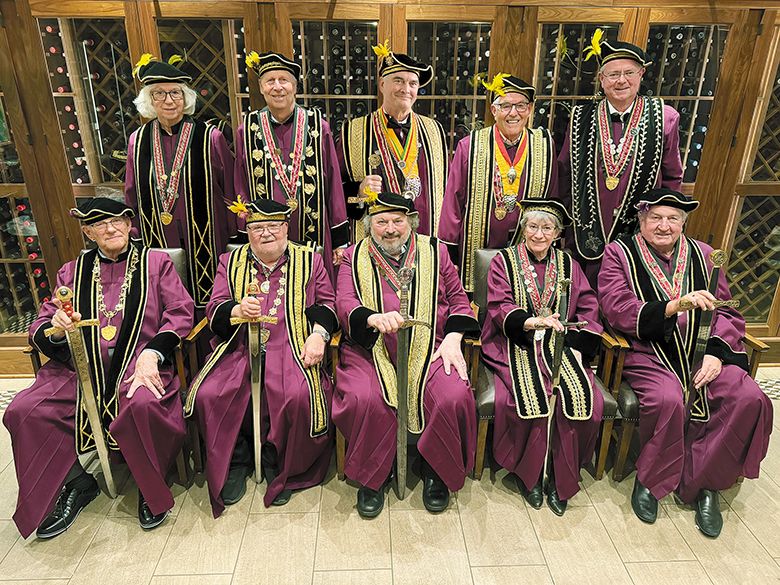
Incorporated in 1996, The Oregon Wine Brotherhood received its official charter from the FICB the following year. Burgundy, black and gold were chosen as the new brotherhood’s colors, inspired by Oregon’s signature Pinot Noir. The emblem was designed by artist and master sommelier Jan Jacobsen in collaboration with graphic designer Ann Garrison. It incorporates evergreen trees, grapevines, raindrops and a Pinot Noir glass– Oregon symbols linking Old World pageantry with the Pacific Northwest.
AN INTERNATIONAL SPLASH
The Oregon Wine Brotherhood’s international debut occurred at the 1996 FICB Wine Congress in Maastricht, Netherlands. Wearing freshly-tailored burgundy robes edged in black velvet, the delegation joined the nearly 30 global brotherhoods present. Oregon, a relatively young wine region, stood shoulder-to-shoulder with the centuries-old traditions of Burgundy, Bordeaux and beyond.
Returning home, The Oregon Wine Brotherhood built on additional momentum. In 2001, under DeBoni’s leadership, the organization hosted the FICB International Congress in Portland, marking the second time it had been held in the United States.
THE BROTHERHOOD TODAY
The Brotherhood remains active through international wine excursions, two annual local celebrations, education and philanthropy. Despite its name, women participate fully and contribute essential energy and leadership to the entirely volunteer-run organization.
New members are inducted at the convivial Assemblage held each spring. As the Brotherhood gathers to socialize, its members preserve the pageantry that has long defined wine guilds. The formality of regalia, swords and medals contrasts with the Pacific Northwest’s casual sensibilities.
“I think it harkens back to a time when things were not as easy as they are today,” observes Josh Bratt, the Brotherhood’s current Master Commander. “Having a set of disciplines and some security and organizational strength in place was extremely important for the survival of these guilds,” he adds.
Each fall’s barrel tasting raises funds, with proceeds benefiting the Brotherhood’s many philanthropic efforts. Through its scholarship program, the organization provides financial support to students pursuing viticulture, enology, wine marketing and hospitality studies at Oregon colleges and universities. Over the past two decades, more than $250,000 in scholarships has been awarded.
“The Oregon Wine Brotherhood has been a wonderful partner for Linfield [University] and our Wine Studies Program,” reports Joseph Hunter, the McMinnville school’s vice president for University Advancement. The funds are appreciated as the school increasingly attracts talented students with full financial need. “This scholarship helps ensure access to education and opportunity, as we cultivate future leaders in the wine industry.”
Beyond student aid, the Brotherhood helps fund nonprofits serving vineyard and winery workers and their families, including ¡Salud! and AHIVOY. These partnerships provide education, housing, healthcare and other essential needs– sustaining those at the heart of Oregon’s wine economy.
The group also initiates special projects to promote the continued growth and excellence of the industry. In collaboration with Oregon State University, the Brotherhood is seeking to understand the wine industry's talent and workforce needs within the context of our state’s overall agricultural industry.
“The wine industry is an agricultural business in Oregon, and it's like Christmas trees, grass seed, hops, nursery stock and a host of other things… you’re relying on the same workforce and communities. There's crossover but also competition for those talent resources,” observes Bratt. He envisions gathering data to analyze wine’s human resource needs, “compared to and in conjunction with other agriculturally-based employers.”
A NEW DECADE
Striding into a fourth decade, The Oregon Wine Brotherhood stays true to its founding spirit. Through pageantry, philanthropy, and partnerships, the Brotherhood connects history with today. It continues to safeguard not only a love of wine but also a belief in the community that gathers around it.
To learn more about The Oregon Wine Brotherhood, visit www.oregonwinebrotherhood.org.
Greg Norton is a freelance writer with a broad background in nonprofit communications and the arts. He studied journalistic writing through the UCLA Extension and has traveled to wine regions around the world. Greg is a Certified Specialist of Wine and received the Level II award from the Wine and Spirits Education Trust. When not writing about wine, he can be found pouring it in a tasting room or wine bar near West Linn, where he lives. Read more by Greg at www.onthevine.blog.