Packing a Punch
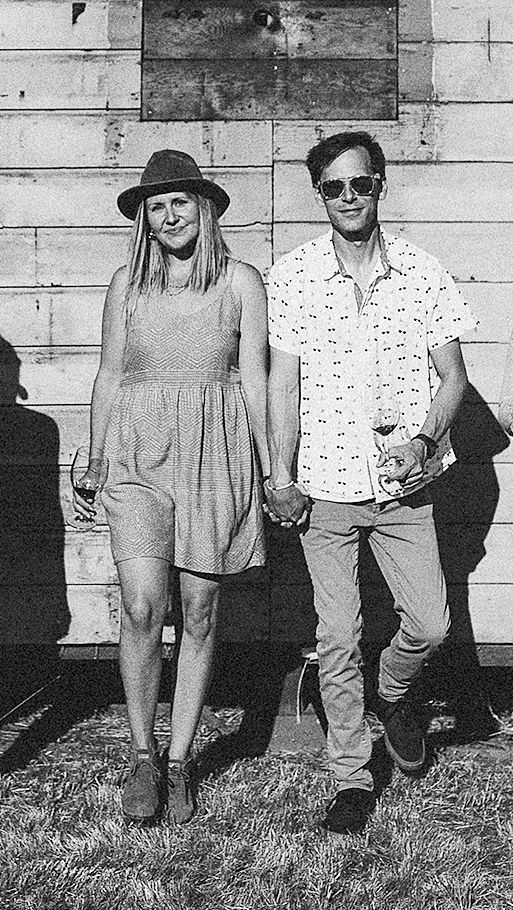
Jon and Melissa LeBars pour Rogue Valley wine with patience and purpose
By Paula Bandy
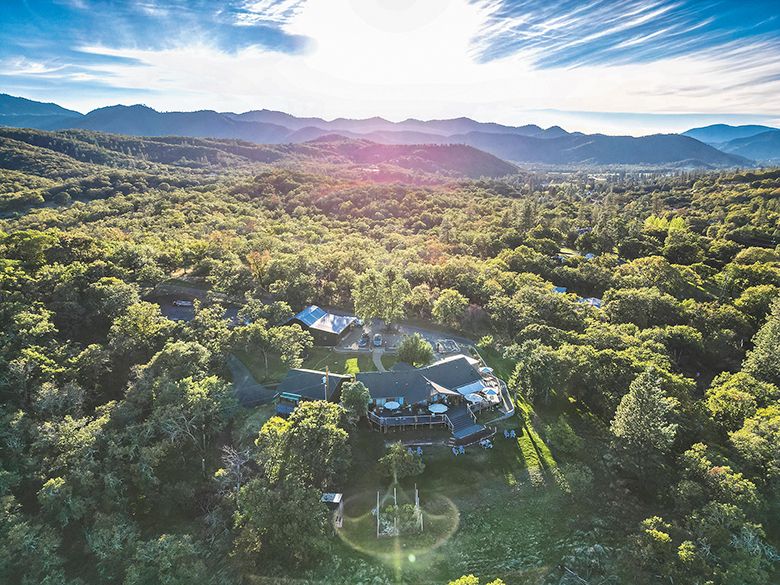
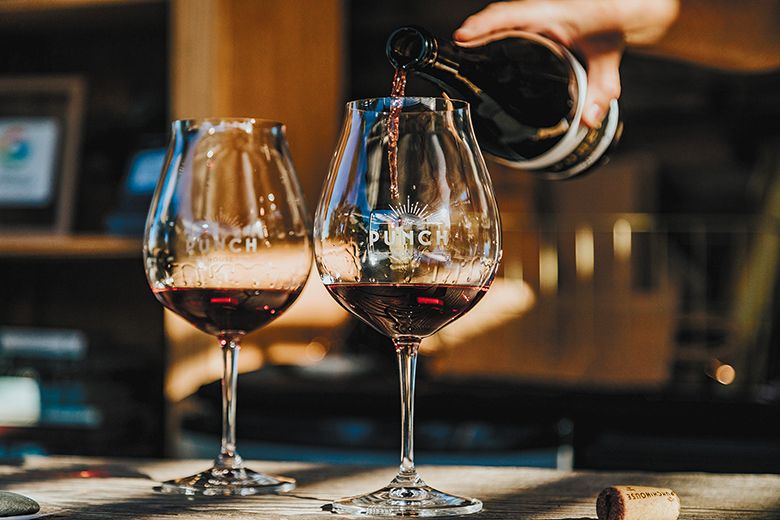
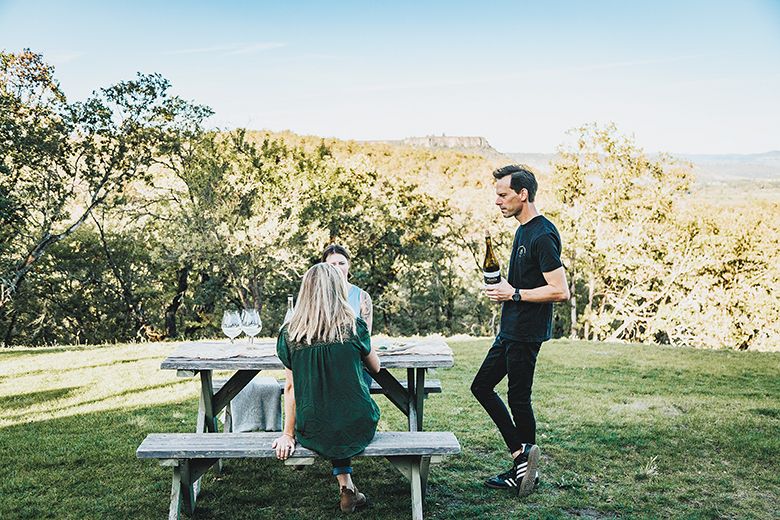
From a deck perched high above the Rogue Valley, glasses clink. Light slips across the ridgelines, the city bustles below. Comfortable furniture takes full advantage of the sweeping view– the Table Rocks, Mount McLoughlin, plenty of sky and the valley beyond. Settling in, the hills are filled with a soundtrack of bird song. Here, wine is poured with ceremony and care. This is The Punch House: a place built slowly, deliberately.
For Jon and Melissa LeBars, wine has never been about spectacle but rather continuity– of place and effort. Their story is not one of sudden arrival or inherited ease, but of accumulation: years layered carefully like sediment, forming a sturdy foundation, one flexible enough to keep growing. That ethos– patient, grounded, deeply personal– influences everything they do.
A Legacy Rooted in Sterling Creek
Jon grew up on Sterling Creek, outside Jacksonville, surrounded by the quiet rhythms of rural living. “I’m an Oregon boy my whole life,” he declares, the phrase carrying with it more than geography. It speaks to a way of moving through the world shaped by land, season and persistence. His parents owned property planted with grapes and made what he calls “garage wine.” It was never commercial, never polished like The Punch House wines.
“In a way,” Jon reflects, “we’re continuing the legacy my parents started without even realizing it.”
In the 1990s, his parents ran a wine-focused program in Jacksonville called Vintage, long before the area became a destination. Hosted at the Britt Gardens, it drew winemakers, musicians, locals and the occasional celebrity– including Patrick Duffy– for tastings beneath the trees. It was intimate and regional, built on curiosity rather than hype.
“I remember wine was always around– being discussed, tasted, shared,” Jon shares. “That was my introduction to the whole wine experience.” This “lived” apprenticeship established an idea early: wine belonged here.
The Art of Care: Melissa’s Way to Wine
While Jon’s roots sink deep into Oregon soil, Melissa’s story begins in the wilderness surrounding the Rogue Valley. Her family moved from Huntington Beach to Williams as she was starting first grade. They traded coastal sprawl for a remote BLM road and constructed a 5,000-square-foot home. Her parents, both nurses, carved out a life of independence and wide-open possibility– one that required an hour-long bus ride to school. Childhood meant trees, forts, dirt and imagination. “It was a great way to grow up,” Melissa marvels. “Tree climbing, fort building… I definitely developed an appreciation for the outdoors.”
Art became her compass. She painted, photographed and entered competitions. “I was pouring into my creative side,” she says. But when photography became transactional, something shifted. “I found it really hard to create something for somebody else in exchange for money,” she explains. “It just felt weird. It’s so different than just doing something and getting lost in it.” The realization was quiet but decisive. That experience was enough for her to set aside the idea of art as a profession.
Life moved forward: marriage, a house, truck and a dog. In 2008, Melissa took a job in a hospital kitchen to help make ends meet. “It was just the beginning of the snowball of finding my path in healthcare,” she adds. “It uses my brain in a way I really enjoy. And then it’s very much an outpouring.”
By 2011, she was an ICU nurse. The work demanded precision, emotional resilience and an unwavering presence. Though she has stepped into management roles, she prefers bedside care. “I’m in my zone then,” she observes. “It all just flows.”
Melissa’s creative impulse never disappeared; it merely evolved. With The Punch House taking shape, those long-honed artistic instincts returned in unexpected ways. “It’s become the way we do our art,” she notes. “Creating spaces, making wine– art in a different way. She laughs at the irony. After stepping away from monetizing her creativity, she's circled back to something ultimately exchanged for money. "But the process feels entirely different," she notes. "Now we're first making wine and then sharing." And that’s really exciting.”
For both Melissa and Jon, wine isn’t just a beverage or business– it’s another medium. And an alternative way to connect care, craft and creativity into work that flows naturally, and literally.
Discovering Wine as a Calling
Early in their marriage, wine slowly entered their world. “We decided to see what this wine thing was all about,” Jon remembers. They started with grocery-store bottles, curiosity leading the way. Things shifted when Melissa’s sister began working in a Willamette Valley tasting room.
“That was our gateway into good wine,” Jon reports– not just quality, but also culture. Story. Place. They visited every Southern Oregon winery they could, and Willamette Valley producers when visiting family. “We got seriously hooked,” he confesses. “We’d always wanted to start a business, something in hospitality, and it soon became clear… wine was the answer.”
Jon immersed himself fully, working for several Southern Oregon wineries, including five formative years at Kriselle Cellars. “I’ll spend the rest of my life thanking them,” he asserts. “For investing in me, and being so open with everything.”
Those years gave him fluency– how cellar work connects to hospitality, how theory meets practice, how decisions ripple outward. While working, he studied at the Oregon Wine Institute. “This way,” he acknowledges, “we could show up and know what we’re doing.”
Though another dream once hovered in the background. “Literally,” he laughs, “my shining star had always been going to Hollywood to make movies.” The filmmaking instinct didn’t disappear; it reframed. Today, Jon channels his cinematic sensibility into The Punch House’s videos through visual storytelling– wine, food, landscape and human moments woven together with mood and ambiance.
Growing Slowly, With Purpose
Licensed in 2017, The Punch House didn’t emerge from leisure or romance. It grew inside real life. Planning years blurred into pandemic years. Fires ignited. Focus narrowed. What remained was commitment. Leading up to The Punch House’s 2021 opening, Melissa worked ICU shifts, wrapped in protective gear. Jon remembers her looking like a tent. Their daughter learned kindergarten through a screen. A son was born. Jon worked days, gathering grapes during lunch breaks and processing fruit late into the night.
The couple sold their house and moved into a rental as they searched for a place that could become home, tasting room, winery and eventually vineyard. Wine, for them, wasn’t an escape from life. It was built directly inside it. “Everybody had a traumatic life at that time,” Melissa recalls. “I was working in a COVID ICU– that’s what ours looked like. It was crazy. However, we’ve always been resourceful, leveraging what we own. We’ll start with this, then sell that to buy something else. We had this awesome VW bus– the money from its sale turned into winemaking equipment, which turned into more equipment.”
Their philosophy is simple: start a business, then scale it. Growth should be parallel– mistakes, lessons and evolution moving together. “It all needs to grow together for things to work well together,” they emphasize. “Very organic.” Authenticity has never been negotiable. “There’s no smoke and mirrors for us,” Jon declares. “We just love wine.” Early on, they briefly considered outsourcing production, but dismissed the idea almost immediately. “That was a hill to die on,” he continues. “We wanted it to be our own creative expression. This is the nectar we offer, this wine we make ourselves.”
Melissa echoes that devotion to detail. “We pine over every grape we bring up the hill,” she admits. “And I think that’s one reason we sell out of our wine every year.”
For now, fruit comes from carefully selected vineyards across Oregon, but the future is visible just beyond their front windows. They plan to plant two acres of vines on the hillside, adding what they jokingly call “grape ambiance.”
The tasting room itself is the large deck of their home, with the winery tucked behind and an Airbnb alongside. The future includes moving to a new house, allowing this one to be opened fully to guests. Windows stretch across the front, framing the landscape. Hospitality here is communal rather than curated.
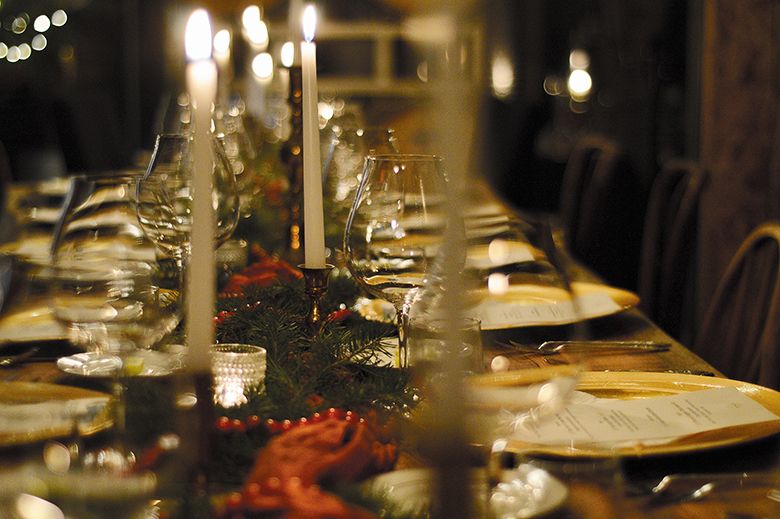
Winemaker dinners glow softly in the barrel room, candles casting warm light across oak barrels as wine and conversation flow. Summer evenings bring outdoor movie nights, films projected against the darkening sky. Pétanque balls clink. Deep couches invite lingering. “We want it to feel like you’re at home,” Jon explains.
Production will remain under 1,000 cases. Pinot Noir and Sauvignon Blanc anchor the lineup, with additional wines when presented with optimal fruit.
“Qualitative, not quantitative,” they agree.
A Creative Experience
As the Rogue Valley enters the national wine conversation, Jon and Melissa feel ready. “We bring our own spin,” Jon notes. “And, as USA Today’s number two wine region in 2025, people are going to visit, expecting a stellar wine experience.”
The Punch House answers that expectation with confidence and playfulness. The name itself speaks to whimsy– a nod to youthful exuberance and a willingness to be a little bit different. Punch means juice, after all, and wine. They began with a single small tank, then a barrel, then two, then four, scaling patiently as the vision took shape. Today, that same philosophy guides everything they do: a careful balance of top-notch craft and approachability, storytelling and sincerity.
“We’re serving real people,” Jon observes, “and we want to do right by them.”
The Punch House stands not only as a destination but also a philosophy shaped by hard years, steady hands and a belief that the best things are built slowly, together.
The Punch House Winery
9115 Blackwell Rd., Central Point
(541) 414-7941
Open Thursday — Sunday, Noon — 5 p.m.
www.punchhousewine.com
Paula Bandy and her dachshund, Copperiño, are often seen at Rogue Valley’s finest wineries, working to solve the world’s problems. She has covered wine, lifestyle, food and home in numerous publications and academic work in national and international journals. For a decade, she was an essayist/on-air commentator and writer for Jefferson Public Radio, Southern Oregon University’s NPR affiliate. Most recently, she penned The Wine Stream, a bi-weekly wine column for the Rogue Valley Times. Paula believes wine, like beauty, can save the world. She’s also a Certified Sherry Wine Specialist and currently sits on the Board for Rogue Valley Vintners. @_paulabandy