
Fire Damages
Wineries pleased to move on from PacifiCorp lawsuit
By Ossie Bladine
There were no bottles of Oregon sparkling wine being popped at the end of October following a $125 million settlement agreement with PacificCorp that allows 93 wineries to recoup some losses from their 2020 vintage.
“There’s no victory lap. There’s no chest pounding. There’s no celebration on me or my family’s part or the other wineries that I know of,” said Alex Sokol Blosser of Sokol Blosser Winery.
There was plenty of relief, however, after years of building a case and preparing for a lengthy civil trial.
“I’m just grateful it’s over,” Sokol Blosser said.
The plaintiffs ranged from some of the state’s largest wine businesses, like Willamette Valley Vineyards and King Estate Winery, to small, family-owned and -operated wineries and vineyards; all seeking damages to their product caused by smoke taint from the 2020 Labor Day wildfires.
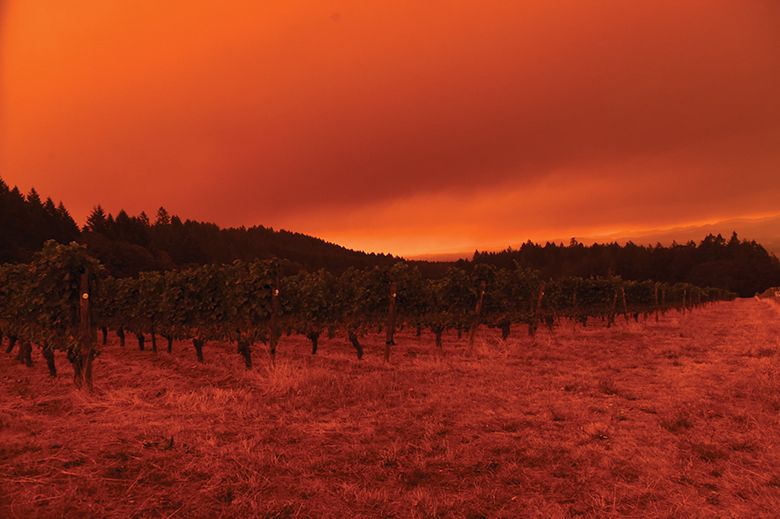
Seven simultaneous megafires ignited during Labor Day weekend in 2020, along with 12 smaller fires, worsened by hot dry east winds moving at more than 30 miles an hour, with gusts up to 60 miles an hour. More than a million acres burned, destroying over 4,000 homes and killing 11 people. The fires largely destroyed the towns of Detroit and Gates in the Santiam River Canyon and Phoenix and Talent in Southern Oregon.
The wineries accused PacifiCorp of responsibility for five of the fires, and that smoke from the disasters tainted their grapes, resulting in lost income and damaged reputations.
“Grapes and grape juice that are infused with smoke can carry the smoke compounds and smoke taste through the entire wine production, bottling process and sale to the consumers,” the lawsuit stated.
Between the fires and harvest that September, Elk Cove Vineyards owner and winemaker Adam Campbell and many industry peers gathered to discuss ways to work with the smoke-impacted fruit.
“We all left there pretty disappointed and discouraged,” Campbell said. “It was really obvious really quickly that we were going to be in a losing situation.”
It was easier to mitigate issues with white wine grapes. But because red wine is fermented with the skins, the winemakers knew it would be difficult to create red wines acceptable to the market.
Campbell described smoke taint as an ashtray or creosote chemical aroma and flavor. “It’s not like you can say, ‘oh, I like smoky wines, this will be good.’”
Some wineries chose not to pick the harvest at all, while others made small batches or sold their product for bulk wine at discounted prices.
As a small, family-owned business, Campbell said they tend to want to look forward.
“When we do have losses like that — maybe it’s just part of our personality — we tend to try not to dwell on them, and we just try to move on,” he said. “This was an example of where we really needed to look at and be honest with ourselves about what our losses were.”
Sokol Blosser said they sold most of the 2020 wine they made, but then the marketplace started pushing back. They received calls from distributors that the wine was turning bad as it aged in bottles. Pallets of cases were returned and have remained in their warehouse until Sokol Blosser finds a way to get rid of it. One option may be to give it to a distiller, if he can find one to pay for the shipping. He noted some of their settlement money may have to be used to discard the remaining cases.
When winemakers started to propose legal action, “it seemed like a long shot,” Sokol Blosser said. “Sometimes being right ceases to matter.”
Willamette Valley Vineyards owner Jim Bernau invited attorney Robert “Bob” Julian of San Francisco, well known for handling wildfire-related civil cases, to a blind tasting at Domain Willamette in Dayton, to determine if the wineries had a case to be made for damages.
Quickly, “I could tell it was a real case,” Julian said.
The attorney credited Campbell, Sokol Blosser and Bernau in leading an outreach and informational campaign to get more plaintiffs to join the lawsuit.
“I can’t say enough about how good they were as clients and as leaders in the industry to get the word out and to get people to file their claims,” said Julian, who partnered with attorneys Mikal Watts of Austin, Texas, and Greg Lusby of Eugene as counsel for the plaintiffs.
Bernau was equally as complimentary about their attorney.
“He really was the one that we needed to recruit to build our case to help Oregon wineries (and vineyards) recover,” Bernau said, noting the attorneys agreed to take the case without any fees until a settlement. “We didn’t have the money to pay them; we were terribly damaged financially. … So I’m very grateful to Bob Julian, because (he) made it possible for the Oregon wine industry to seek and obtain recovery.”
With Julian on board, Elk Cove filed a lawsuit in Yamhill County on July 14, 2023, and Willamette Valley Vineyard filed a similar one in Marion County the following week.
The actions followed a June 2023 jury verdict that found PacifiCorp grossly negligent in causing four of the fires. The class action lawsuit lasted seven weeks, and jurors awarded more than $70 million in damages to the plaintiffs, mostly homeowners in the western Cascades area, after finding PacifiCorp guilty of gross negligence.
The next step for the wineries was to recruit others to join.
“We had to have a big enough group to interest these big law firms who really understand this part of the law,” Bernau said.
Sokol Blosser filed a third lawsuit in Multnomah County in Jan. 2024, following the first of two industry meetings in McMinnville to inform wineries about the litigation efforts.
Campbell and Sokol Blosser both said at first there was not much hope anything would come of the lawsuits. They believed their argument was sound, “it just seemed like a long shot,” Sokol Blosser said.
Winery business owners were able to ask questions at the informational meetings held and learn what would be involved in the legal battle. Campbell said he made sure to be honest about the heavy workload to gather and organize financial information to prove their losses were caused by the wildfires. He also praised his CFO Robert Verant, and all the other wineries’ staffers, who working through depositions, calculating losses and working with lawyers thought the case.
Julien noted the smoke infiltration caused a variety of issues that led to financial loss.
“Some didn’t pick. Some picked and cleaned the smoke out because they could. Some weren’t able to clean it out,” the attorney said. “Everyone’s damages were different, and some damage was not known until later as the wines aged in bottles.”
And there was no “arm-twisting” to urge people to join, Sokol Blosser said. The message was, “You’re a smart individual, and here’s the situation. If you’re in, great. If you’re out, great,” he said. “I had brothers and sisters in the industry who joined it, and a lot of brothers and sisters who decided against it. I think everyone made the right decision.”
With nearly 100 plaintiffs involved, Julian was confident in their case.
“I had the same speech every time: Give me a trial date, and I promise this case will settle,” he said.
On Oct. 2, a motion for continuance by the defense in the case with Sokol Blosser was denied. Trial was set to begin Nov. 3.
The settlement was announced Monday, Oct. 20.
“If it would have gone to trial, you would have seen a lot of blood and guts,” Sokol Blosser said. “I think we’re all grateful that we were able to come and reach this agreement.”
In announcing the settlement, the plaintiffs’ legal team complimented PacifiCorp for resolving the winery matters and for addressing its infrastructural safety issues since the deadly fires.
In a Nov. 3 quarterly earning statement, PacifiCorp owner Berkshire Hathaway said the private utility company faces a potential “liquidity crisis” stemming from the many lawsuits related to the wildfires.
Bernau said there was a sense of “we’re in this together” by the end of the case and it’s important for business and government officials to continue working on issues related to wildfires and safety.
“What we need to do is, people in the business community, we have to support our private utilities like PacifiCorp and Portland General Electric,” he said. “(PacifiCorp) has made a lot of good changes inside their organization.”
The settlement did not fully recover wineries’ losses from the 2020 vintage — far from it, the business owners said.
“But it’s nice to have the ability to pay off some of the debt incurred,” Campbell said. “We’re just happy to see it in the rearview mirror.”
This article was originally published in the News-Register.
A fourth-generation publisher, Ossie Bladine grew up in the News-Register’s newsroom and studied at the University of Oregon. He resides in McMinnville with wife Lacy and children Kingsley, Sloane and Axel. When he’s not balancing the multiple segments of the company, he’s busy planning the Walnut City Music Festival.