Elevated Status
Eola-Amity Hills celebrates 20 years
By Greg Norton
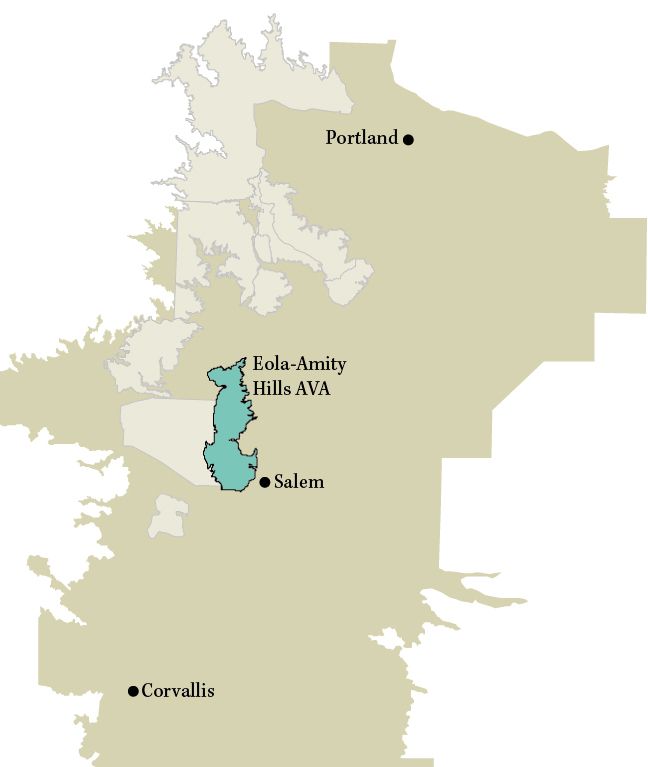
A “nested AVA” might sound like something sought by a birdwatcher. In the U.S., the term refers to American Viticultural Areas, some within larger winegrowing appellations. Designated in July 2006, the Eola-Amity Hills, Willamette Valley’s fifth nested AVA, celebrates its 20th anniversary this year.
SIZE MATTERS
After the Willamette Valley AVA was established in 1983, wineries could more accurately indicate a wine’s origin. “Nobody had ever heard of the Willamette Valley at that point,” recalled Pat Dudley, Bethel Heights Vineyard co-founder and wife of Eola-Amity Hills petitioner Ted Casteel. “We were all busy trying to distinguish it from Oregon as an appellation.”
The Willamette Valley AVA covers 3.5 million acres spanning over 100 miles from north to south. Soon after the turn of the 21st century, it became obvious more precise geographical distinctions were needed. “It’s really big,” Dudley continued, “and we didn’t stop to analyze whether all parts of the Willamette Valley were equally suitable for growing high-quality grapes.”
In 2002, petitions for six nested AVAs were submitted to the federal government for approval. The proposed name, Eola Hills, drew negative comments because an established winery already used that name. It took time to consider other options, so Eola-Amity Hills was among the last of the original six to receive approval.
A NEW WIND BLOWS
The towns of Eola and Amity generally mark the north and south boundaries. According to “Oregon Geographic Names,” Eola was initially named “Cincinnati” in 1851, but was soon renamed after Aeolus, the Greek god of winds.
“That Eola wind is what makes the whole Valley such an amazing Pinot growing region,” noted Erin Nuccio, owner and winemaker of Evesham Wood and Haden Fig wines. Cool, westerly winds from the Pacific Ocean draft through the Van Duzer Corridor in the coastal range. “In the Eola-Amity Hills, we kind of get the brunt of it and get the biggest influence,” he explained. The marine breezes, along with the east slope’s Jory soils and the sedimentary soils found on the west, contribute to the distinct liveliness of the area’s wines.
The hills are characteristic features of the appellation. Most vineyards in the Eola-Amity Hills are between 200 and 700 feet in elevation. Nuccio has the tracing paper overlay used by his predecessor, Russ Raney, another petition author. “When Russ was drawing those boundaries, elevation was a significant issue. On the lower end, the soil changes… but at the upper elevations, Russ was concerned that, in cooler years, fruit would not fully ripen.” Nuccio noted climatic conditions have shifted since then. In addition to an overall warming trend, there are wider swings between warm and cool growing seasons. Some of the higher sites have emerged as reliable and sought-after sources of fruit.
WORLD CLASS
Last summer, Bethel Heights’ 2023 “The High Wire” Chardonnay became the first Oregon wine to receive a 100-point rating from Decanter magazine. North American editor Clive Pursehouse described it as “good as anything made anywhere in the world.” Dozens of the Eola-Amity Hills Chardonnays and Pinot Noirs have garnered high scores and acclaim, including a “Best in Class” at this year’s San Francisco Chronicle competition for Björnson Vineyard’s 2023 Reserve Pinot Noir.
“In 2024, three of Oregon’s six wines on Wine Spectator’s Top 100 came from this tiny area, even though it produces only a fraction of the state’s grapes,” noted Mark Björnson, founder and owner of Björnson Vineyard, in a recent press release. “Eola-Amity Hills has quickly become one of the world’s top wine regions.”
Equinox
Sat., May 2, 4–8 p.m.
Zenith Vineyard, 5657 Zena Rd. N.W., Salem
Tickets: $75 general / $125 premier
Educational panels, noon–3:30 p.m., at Lingua Franca: $50 each
eolaamityhills.com/events
Greg Norton is a freelance writer with a broad background in nonprofit communications and the arts. He studied journalistic writing through the UCLA Extension and has traveled to wine regions around the world. Greg is a Certified Specialist of Wine and received the Level II award from the Wine and Spirits Education Trust. When not writing about wine, he can be found pouring it in a tasting room or wine bar near West Linn, where he lives. Read more by Greg at www.onthevine.blog.