Couples Therapy: Part One
Five Oregon couples on building wineries, relationships and a shared life
By Aakanksha Agarwal
From harvest chaos to long game decisions, these longtime winery partners show what it really takes to build a business, vineyard and shared life.
For many Oregon wineries, the partnership behind the bottle matters as much as the wine itself. In some cases, they are not only business collaborators but married couples, building a life and winery, side by side.
Running a wine business together requires more than shared passion. It demands aligned vision, clearly defined roles, resilience through difficult vintages and the ability to make long-term decisions when personal and professional lives are deeply intertwined.
The couples featured here have adapted as businesses grew, families changed and the Oregon wine industry itself evolved. From vineyard and cellar to hospitality and operations, each partnership reflects a balance of complementary skills and trust built over time.
Together, their stories offer insight into what it takes to maintain both a winery and a relationship in one of the most demanding agricultural industries, vintage after vintage.
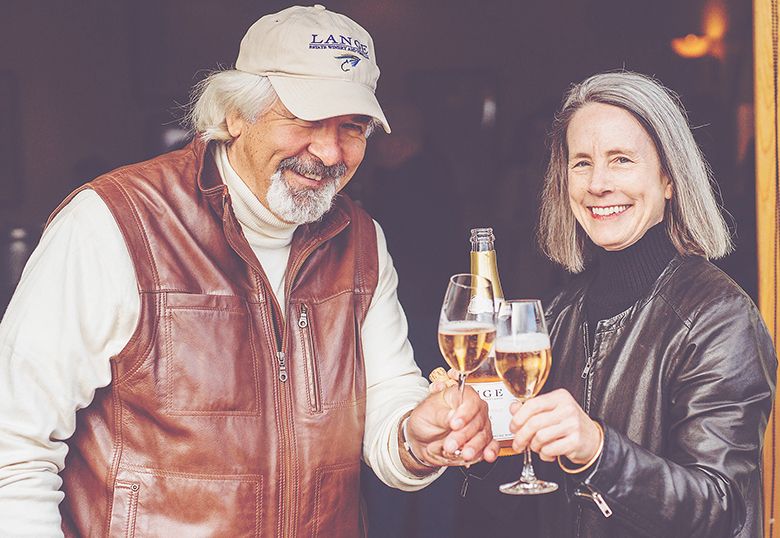
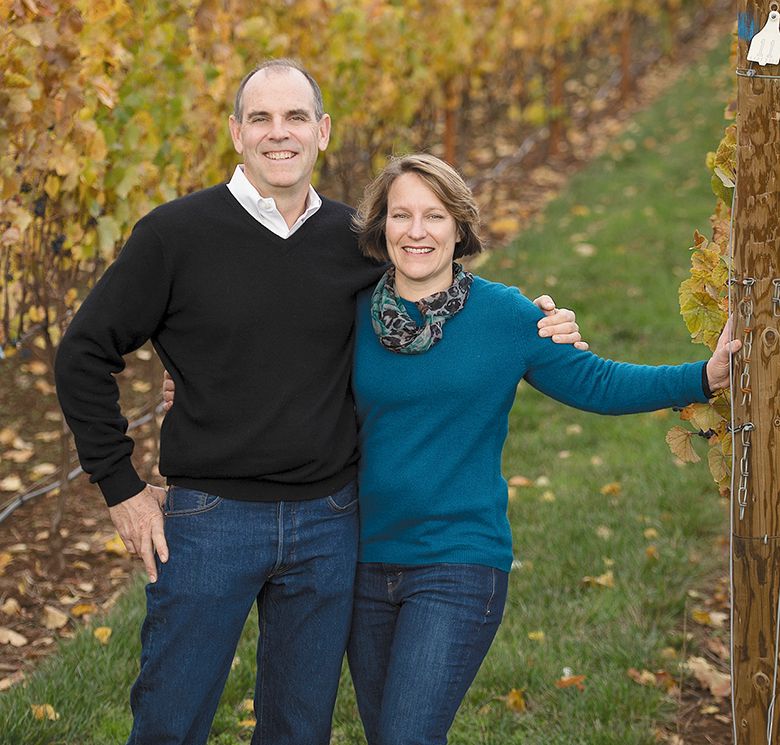
Lange Estate Winery: Don & Wendy Lange
Don and Wendy Lange’s journey into Oregon wine began in 1987 with two bottles of Pinot Noir and a phone call. While working in Santa Barbara, they opened a 1979 Erath Maresh Vineyard and a 1980 The Eyrie Vineyard. Struck by what Don calls the wine’s “typicity,” Wendy suggested calling the winery. “I dialed the number on the bottle,” Don recalls. “Dick Erath came to the phone and we talked for an hour.”
An invitation to visit Oregon soon followed, and the couple found themselves drawn to the North Willamette Valley, where Pinot Noir already showed “all of the finesse, complexity and texture of fine Burgundies.”
From the beginning, their responsibilities were clearly divided. Don led winemaking and vineyard development, while Wendy managed the tasting room, sales, distribution and the financial backbone of the winery, while also helping during crush and bottling. As the business grew, “We both became more specialized in our work,” Don observes.
When disagreements arose, the solution was pragmatic. “However passionate and stubborn we both are, on the business level, we are committed to rationality,” Don explains. “Whoever can make a rational argument and endure it for the longest time wins.”
After nearly four decades together in wine, Don credits one principle for longevity: “Never lose your sense of humor.” Winters can be long and challenging, especially when “it hangs on until June,” but perspective mattered. “We’ve always been sustained by the recognition we have the good fortune to live in Oregon.”
As their son Jesse joined the Dundee Hills winery, transitions unfolded organically. “We never leaned on Jesse to join the business,” Don shares. “He was raised with the core values and brings those to work with him every day.”
Asked what still brings joy after all these years, Don doesn’t hesitate: “Just look around. Gorgeous views. Beautiful mountains and rivers. A fantastic food and wine culture. Friends, colleagues and family held closely. Joyously.”
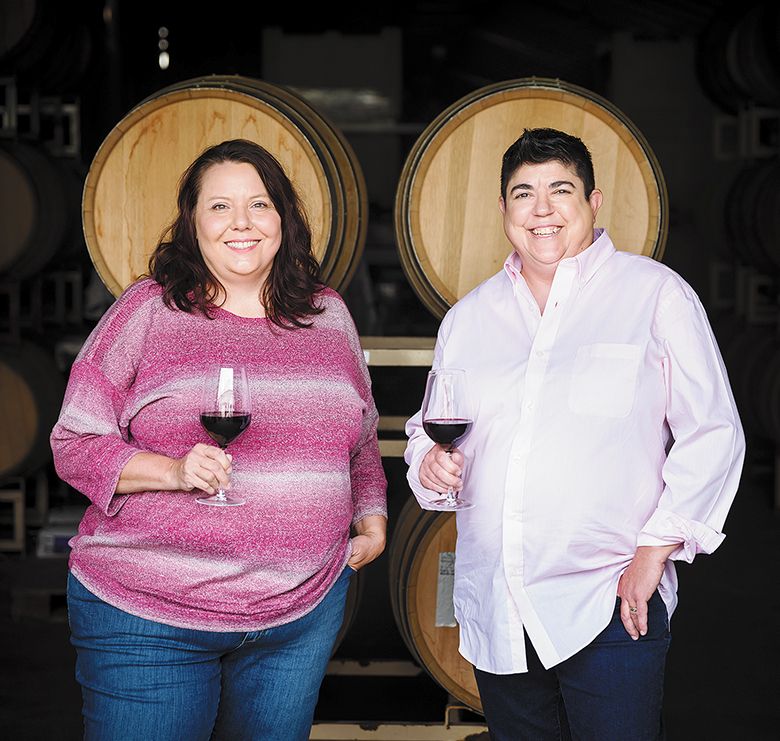
Hip Chicks do Wine: Renee Neely & Laurie Lewis
Hip Chicks do Wine began after years of friendship, curiosity and weekend wine tasting evolved into something more ambitious. Laurie Lewis had recently moved to Portland and volunteered at the Portland Women’s Theatre Company, where Renee Neely worked as both an actor and artistic director. By 1996, the two were a couple, visiting wineries across Oregon and talking seriously about what might come next.
They ultimately landed on winemaking, despite having no formal experience. Lewis recalls a moment of clarity that helped dissolve her doubt: “Men do it all the time.” With that confidence, they began making wine at home in five-gallon batches and enrolled in classes at Chemeketa Community College. They released their first commercial vintage, under the Hip Chicks do Wine label, in 1999, producing 500 cases across four wines.
The early years were defined by long hours, financial risk and exhaustion. Both worked demanding day jobs while building the winery at night. In 2001, they opened their Southeast Portland tasting room and welcomed a baby the same year. Lewis remembers bottling wine until 2 a.m. while their nine-month-old slept nearby. “I definitely felt like I was stretched thin and didn’t feel like I was doing anything very well,” she admits.
The financial stakes were enormous. “We put in all of our savings, took out a second mortgage on the house we owned, cashed in our 401(k)s and ran up every credit card we could get,” Lewis confesses.
Over time, their roles became clearer. Neely gravitated toward daily winery operations, while Lewis focused on lab work, bookkeeping, sales tracking and communication. As Neely explains, “Once we figured out our strengths, we really tried to focus and capitalize on those.”
More than 25 years later, Hip Chicks do Wine remains proudly urban, openly queer-owned and deeply food-focused. For Lewis, the greatest joy comes from watching guests connect wine and food. “When the wine and food pairing is magic, it’s a great thing to see.” Neely sums up their philosophy more simply: “We make wine you can drink today or cellar and enjoy in the future.”
Björnson Vineyard: Mark & Pattie Björnson
Mark and Pattie Björnson did not begin with dreams of Pinot Noir but with a shared long-term vision. They met at the University of Minnesota through a co-ed business fraternity, where Pattie interviewed Mark as part of the pledging process. When she asked about his goals, his answer stood out. He wanted to live in the country, grow a large garden, build a house with a big fireplace and raise a family. Pattie remembers thinking how unusual that kind of clarity felt in the 1980s.
Her joking reply– “Oh wow, look me up when you want to get married”– turned out to be prophetic.
They married in 1989 and postponed a honeymoon until 1993, when they embarked on a month-long tandem bicycle trip through Europe with their toddler riding between them. Along the Mosel and Rhine rivers, they stayed at small, family-run wineries and found themselves drawn to vineyard life. That experience planted the seed for a future vineyard and winery, and back in the States, Oregon stood out as an up-and-coming region.
The move from Minneapolis to Oregon took years to materialize. “Everybody thinks you’re crazy, you need to stop telling people we are moving to Oregon!” Pattie remembers telling Mark.
Their long-time dream became real in 2004 when Mark’s job relocated. The family arrived the following year and fell in love with the first property they toured.
Today, Björnson Vineyard includes 28 planted acres on the 107-acre property, much of it forest and riparian land, located in the Eola-Amity Hills. In 2013, the couple purchased a second site nearby in the Van Duzer Corridor, naming it Pamar Vineyard.
Their division of labor reflects practicality. Pattie oversees the winery, tasting room and direct-to-consumer sales, while Mark focuses on vineyard management and grape contracts. Pattie describes the approach as “divide and conquer,” influenced by four children, outside careers and sheer workload.
Their advice to younger couples is grounded and direct: take viticulture and enology classes, build community, avoid rushing scale and keep financial reality firmly in view. As Pattie puts it, “Don’t quit the day job,” because “a winery is incredibly capital-intensive.”
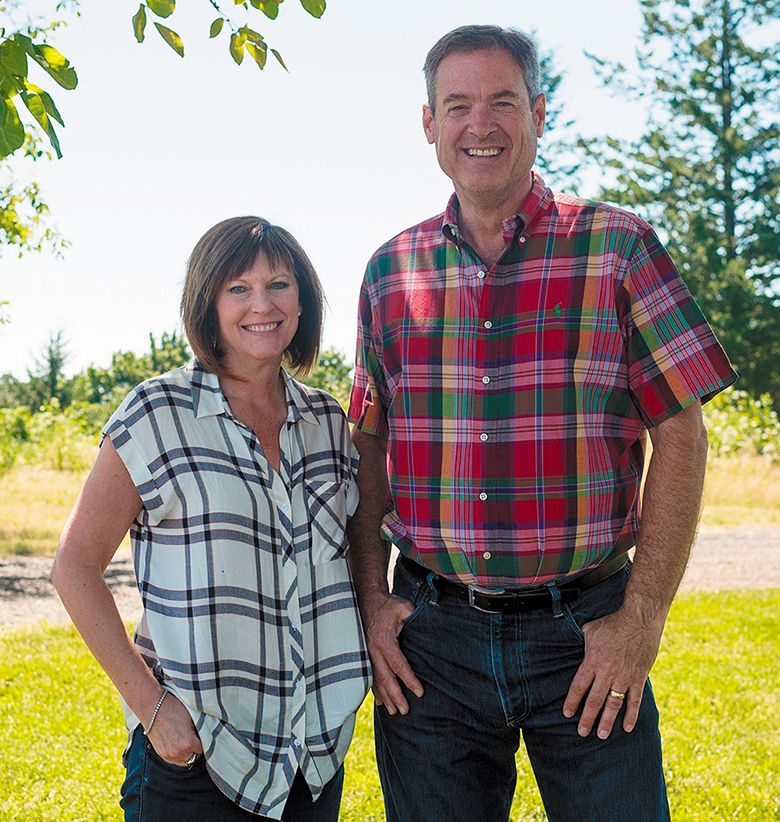
Bryn Mawr Vineyards: Jon & Kathy Lauer
When Jon and Kathy Lauer committed to Bryn Mawr Vineyards in 2009, the decision was less a calculated pivot than a familiar leap of faith. “Jon and I have a habit of making important life decisions somewhat impulsively,” Kathy explains. After tasting the first wine produced from the vineyard, the choice felt inevitable.
“We looked at each other and said, ‘Yep, we are really going to do this.’”
At the time, they had little understanding of what it would take to run a successful vineyard and winery, only the conviction that it felt right. In the early years, geography affected their partnership. Kathy remained a full-time partner at a global law firm in San Diego while their son finished high school. Meanwhile, Jon handled vineyard and winemaking operations in Salem.
Kathy stayed closely involved despite the distance, weighing in on major decisions, helping at harvest and pouring wine in what was then the basement of their home.
As Bryn Mawr expanded, so did its organizational structure. Employees were hired, vineyard management was outsourced, and their children, Krista and David, joined the business. Jon transitioned into a more traditional CEO role, and in 2023, Kathy retired from law to become co CEO. “We now share the executive function,” she notes.
The greatest test came in 2020. A newly completed tasting room opened as COVID shut everything down. Staffing challenges, sales uncertainty, remote legal work and wildfires compounded the stress. “It was a devastating and frank reminder of how nature poses the greatest risk in our business,” Kathy asserts.
Over time, risk has taken on new meaning. What once centered on learning the craft has shifted toward stewardship and responsibility. Kathy now wonders “how we can position Bryn Mawr to become a legacy winery,” one that supports not only the Lauer family but others as well. Her advice to their younger selves remains simple: “Be patient. It’s going to be a wild ride.”
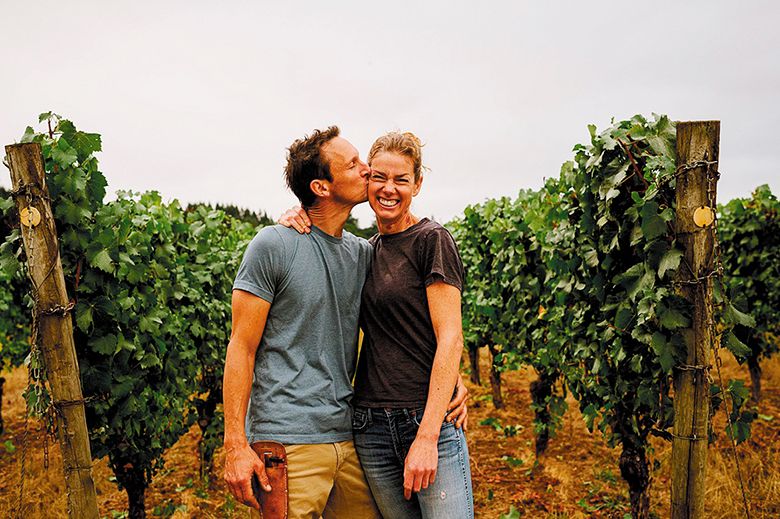
Folly of Man: Tracy & Aaron Kendall
Folly of Man may be a young wine brand, but the partnership behind it is anything but new. Tracy and Aaron Kendall have spent more than a decade building parallel and overlapping careers in Oregon wine, first crossing paths at Adelsheim Vineyard in 2011, where Aaron was cellarmaster and Tracy an intern who later became enologist. They worked side by side for four years, forming what Tracy describes as a foundation of “deep friendship and respect” that has sustained both their personal and professional lives ever since.
“We both learned early on that as soon as you feel like you know how to make wine, you’ve essentially stopped learning,” Tracy recalls. That philosophy now anchors Folly of Man, a project rooted in the belief that “the best Pinot Noir and Chardonnay are yet to be produced,” and that humility and curiosity must remain central to the work. As two winemakers with distinct but complementary instincts, they rarely take the easy route. “Anytime one of us believes there’s a right way to do things, the other inevitably disagrees,” she admits. “That process means we’re constantly pushing each other to do better.”
Before launching their Eola-Amity Hills winery, the couple worked separately at Beaux Frères and Nicolas-Jay, supporting each other through demanding roles while prioritizing family, shared responsibilities at home and life beyond the cellar. The decision to leave those deeply fulfilling positions to build something together was painful but necessary. “The only way to continue with these careers we felt so passionately about was to find a way to do it together,” Tracy observes.
Today, Folly of Man reflects that integration. Aaron leads farming with an intensity and attention to detail that Tracy admires, while she steers strategy, logistics and the business side of the winery. Winemaking remains a fully collaborative process, shaped by years of shared experience, debate and trust. “Every decision is a discussion,” Tracy notes. “We never settle for good enough.”
Despite different paths and distinct challenges these couples have faced, certain patterns emerge: complementary skills, clear communication and a recognition that the relationship itself must remain the priority.
Be sure to read Part Two in next month’s issue.
Aakanksha Agarwal is a wine, travel and lifestyle writer from India. Formerly a Bollywood stylist, she now resides in the U.S., embracing writing full-time while juggling family life and indulging in her passions for cuisine, literature and wanderlust.